MCQ
Which of the following is not true for this progressive wave $y = 4\sin 2\pi \left( {\frac{t}{{0.02}} - \frac{x}{{100}}} \right)$ where $y$ and $x$ are in $cm$ & $t$ in $sec$
  • A
    Its amplitude is $4 cm$
  • B
    Its wavelength is $100 cm$
  • C
    Its frequency is $50$ cycles/sec
  • Its propagation velocity is $50 \times {10^3}\,cm/sec$
Answer

Correct option: D.
Its propagation velocity is $50 \times {10^3}\,cm/sec$
d
(d) $y = 4\sin 2\pi \left( {\frac{t}{{0.02}} - \frac{x}{{100}}} \right)$.

Comparing this equation with $y = a\sin 2\pi \left( {\frac{t}{T} - \frac{x}{\lambda }} \right)$

$v = \frac{{{\rm{Co - efficient \,of\, }}t}}{{{\rm{Co - efficient\, of\, }}x}} = \frac{{1/0.02}}{{1/100}}$

Need a full question paper?

Generate a complete, print-ready paper with questions like this in minutes — across 16+ boards, with answer keys.

Start Generating Free

Similar questions

The resultant amplitude of amplitude $a_1$ and $a_2$ with same frequency while phase difference $\frac{\pi}{2}$.
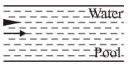
A bullet of mass $200\,g$ having initial kinetic energy $90\,J$ is shot inside a long swimming pool as shown in the figure. If it's kinetic energy reduces to $40\,J$ within 1s, the minimum length of the pool, the bullet has a to travel so that it completely comes to rest is $.....m$
What is kinetic energy?
Let escape velocity of a body kept at surface of a planet is $u$. If it is projected at a speed of $200 \%$ more than the escape speed, then its speed in interstellar space will be ...........
A closed container contains a homogeneous mixture of two moles of an ideal monatomic gas $(\gamma=5 / 3)$ and one mole of an ideal diatomic gas $(\gamma=7 / 5)$. Here, $\gamma$ is the ratio of the specific heats at constant pressure and constant volume of an ideal gas. The gas mixture does a work of $66$ Joule when heated at constant pressure. The change in its internal energy is. . . . . . .Joule.
If a shell fired from a cannon, explodes in mid air, then
Two bodies are projected from ground with same speeds $40 ms ^{-1}$ at two different angles with respect to horizontal. The bodies were found to have same range. If one of the body was projected at an angle of $60^{\circ}$, with horizontal then sum of the maximum heights, attained by the two projectiles, is $.......m$. (Given $g =10 ms ^{-2}$ )
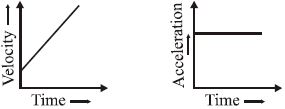
The velocity-time and acceleration-time graphs of a particle are given as Its position-time graph may be gvien as
A particle is projected up with an initial velocity of $80\;ft/\sec $. The ball will be at a height of $96\;ft$ from the ground after
If a gymnast sitting on a rotating stool with his arms outstretched, suddenly lowers his hands: