MCQ
Which of the following is paramagnetic
  • $O_2^ + $
  • B
    $C{N^ - }$
  • C
    $CO$
  • D
    ${N_2}$

Answer

Correct option: A.
$O_2^ + $
(a) $B.O. =$ $\frac{1}{2}[10 - 5] = \frac{5}{2} = 2.5$, paramagnetic

Need a full question paper?

Generate a complete, print-ready paper with questions like this in minutes — across 16+ boards, with answer keys.

Start Generating Free

Similar questions

Which one of the following species is diamagnetic in nature
The Gibbs energy change (in $J$) for the given reaction at $\left[ Cu ^{2+}\right]=\left[ Sn^{2+}\right]=1\, M$ and $298 \,K$ is:

$Cu ( s )+ Sn ^{2+}( aq ) \rightarrow Cu ^{2+}( aq )+ Sn ( s )$

$\left( E _{ Sn ^{2+} \mid Sn }^{0}=-0.16\, V , E _{ Cu ^{2+} \mid Cu }^{0}=0.34\, V \right.$ Take $F=96500\, C\, mol ^{-1}$ )
One mole of $O_{2(g)}$ and two moles of $SO_{2(g)}$ were heated in a closed vessel of one-litre capacity at $1098\, K$. At equilibrium $1.6\, moles$ of $SO_{3(g)}$ were found. The equilibrium constant $K_c$ of the reaction would be
The following reaction is described as
$C{l_2} + \mathop {NaOH}\limits_{{\rm{(dil}}{\rm{. and}}\,{\rm{cold)}}} $ $\longrightarrow$ $A + B + H_2O$ The anions of $A$ and $B$ are respectively ______
The $IUPAC$ name of  is
Which of the following is diamagnetic
Following solutions were prepared by mixing different volumes of $NaOH$ and $HCl$ of different concentrations

$(a)\;\;60\; \mathrm{mL} \frac{\mathrm{M}}{10}\; \mathrm{HCl}+40 \;\mathrm{mL} \frac{\mathrm{M}}{10} \;\mathrm{NaOH}$

$(b)\;\;55\; \mathrm{mL} \frac{\mathrm{M}}{10}\; \mathrm{HCl}+45 \;\mathrm{mL} \frac{\mathrm{M}}{10} \;\mathrm{NaOH}$

$(c)\;\;75\; \mathrm{mL} \frac{\mathrm{M}}{5}\; \mathrm{HCl}+25 \;\mathrm{mL} \frac{\mathrm{M}}{5} \;\mathrm{NaOH}$

$(d)\;\;100\; \mathrm{mL} \frac{\mathrm{M}}{10}\; \mathrm{HCl}+100 \;\mathrm{mL} \frac{\mathrm{M}}{10} \;\mathrm{NaOH}$

$pH$ of which one of them will be equal to $1$ ?
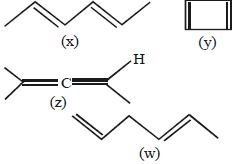
The correct stability order of following species is
Which of the following compound has the smallest bond angle $(X -A -X)$ in each series respectively ?
  $(A)$   $OSF_2$     $OSCl_2$    $OSBr_2$
  $(B)$   $SbCl_3$     $SbBr_3$     $SbI_3$
  $(C)$   $PI_3$     $AsI_3$    $SbI_3$