MCQ
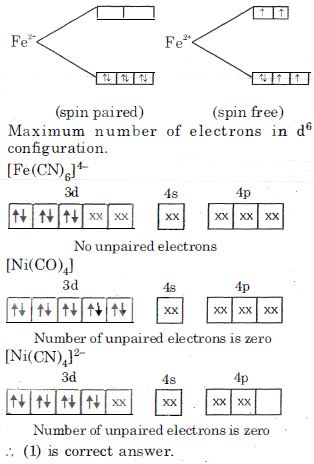
Which of the following is spin-free complex?
  • $[Fe(H_2O)_6] Cl_2$
  • B
    $K_4[Fe(CN)_6$
  • C
    $[Ni(CO)_4]$
  • D
    $[Ni(CN)_4]^{2-}$

Answer

Correct option: A.
$[Fe(H_2O)_6] Cl_2$
a

Need a full question paper?

Generate a complete, print-ready paper with questions like this in minutes — across 16+ boards, with answer keys.

Start Generating Free

Similar questions

On boiling an aqueous solution of $KCl{O_3}$ with iodine, the following product is obtained
The total number of possible isomers of the complex compound  is

$\overset{\left( II \right)}{\mathop{\left[ Cu{{\left( N{{H}_{3}} \right)}_{4}} \right]}}\,$     $\overset{\left( II \right)}{\mathop{\left[ PtC{{l}_{4}} \right]}}\,$
The activation energy for a simple chemical reaction $A \to B$ is ${E_a}$ in forward direction. The activation energy for reverse reaction
A concentrated solution contains high amount of $.......:$
Following is the graph between $(a-x)^{-1}$ and time $t$ for second order reaction if $\theta  = {\tan ^{ - 1}}\left( {\frac{1}{2}} \right)$ ; $OA = 2\,L\,mol^{-1}$ then rate at the start of reation will be $ [$ in $L\, mol^{-1}\,min^{-1}]$
The reaction $C{H_3}COOH + C{l_2}\xrightarrow{P}ClC{H_2}COOH + HCl$ is called
Which of the following will give $-ve$ Tollen's but $+ve$ Iodoform test.
A fixed amount of glucose is dissolved in $100\ gm$ water to form a solution that freezes at $-0.2\,^oC$ . The solution is cooled down to $-0.25\,^oC$ . ......... $gm$ of  ice would have separated.
A $4$ ampere is passed through a solution of zinc sulphate for $50\, minutes$. Find the amount of zinc deposited at the cathode ............. $\mathrm{g}$
Following figure shows dependence of molar conductance of two electrolytes on concentration. $\Lambda \stackrel{0}{ m }$ is the limiting molar conductivity.The number of Incorrect statement(s) from the following is $...........$

$(A)$ $\Lambda \stackrel{0}{ m }$ for electrolyte $A$ is obtained by extrapolation

$(B)$ For electrolyte B, vx $\Lambda m$ vs $\sqrt{ c }$ graph is a straight line with intercept equal to $\Lambda \stackrel{0}{ m }$

$(C)$ At infinite dilution, the value of degree of dissociation approach zero for electrolyte $B$.

$(D)$ $\Lambda \stackrel{0}{ m }$ for any electrolyte $A$ or $B$ can be calculated using $\lambda^{\circ}$ for individual ions.