MCQ
Which of the following is tertiary alcohol
  • A
    $\begin{array}{*{20}{c}}
      {\begin{array}{*{20}{c}}
      {C{H_{  2}}OH\,\,\,\,\,\,} \\ 
      {|\,\,\,\,\,\,\,\,\,\,\,\,\,\,\,\,\,\,\,\,\,\,\,\,} 
    \end{array}} \\ 
      {CH - OH\,{\mkern 1mu} {\mkern 1mu} {\mkern 1mu} {\mkern 1mu} {\mkern 1mu} } \\ 
      {|\,\,\,\,\,\,\,\,\,\,\,\,\,\,\,\,\,\,\,\,\,\,\,} \\ 
      {\,\,C{H_{ 2}}OH\,\,\,\,\,\,\,\,\,\,} 
    \end{array}$
  • B
    $\begin{array}{*{20}{c}}
      {\begin{array}{*{20}{c}}
      {C{H_2}\,\,\,\,\,\,\,\,\,\,} \\ 
      {|\,\,\,\,\,\,\,\,\,\,\,\,\,\,\,\,\,\,} \\ 
      {C{H_3} - C{H_2} - C{H_2}OH\,{\mkern 1mu} {\mkern 1mu} {\mkern 1mu} {\mkern 1mu} {\mkern 1mu} } \\ 
      {|\,\,\,\,\,\,\,\,\,\,\,\,\,\,\,\,\,\,\,} 
    \end{array}} \\ 
      {C{H_2}\,\,\,\,\,\,\,\,\,\,\,\,\,} \\ 
      {|\,\,\,\,\,\,\,\,\,\,\,\,\,\,\,\,\,\,\,\,} \\ 
      {C{H_3}\,\,\,\,\,\,\,\,\,\,\,\,\,} 
    \end{array}$
  • $\begin{array}{*{20}{c}}
      {\begin{array}{*{20}{c}}
      {\,\,\,\,\,\,\,\,\,C{H_3}} \\ 
      \,\,| 
    \end{array}} \\ 
      {C{H_3} - C - OH} \\ 
     \,\, | \\ 
      {\,\,\,\,\,\,\,\,\,C{H_3}} 
    \end{array}$
  • D
    $C{H_3} - C{H_2} - OH$

Answer

Correct option: C.
$\begin{array}{*{20}{c}}
  {\begin{array}{*{20}{c}}
  {\,\,\,\,\,\,\,\,\,C{H_3}} \\ 
  \,\,| 
\end{array}} \\ 
  {C{H_3} - C - OH} \\ 
 \,\, | \\ 
  {\,\,\,\,\,\,\,\,\,C{H_3}} 
\end{array}$
c
It’s Obvious.

Need a full question paper?

Generate a complete, print-ready paper with questions like this in minutes — across 16+ boards, with answer keys.

Start Generating Free

Similar questions

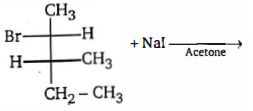
product; $S_{N^2}$ product of the reaction is
Which oxide of nitrogen is not a common pollutant introduced into the atmosphere both due to natural and human activity ?
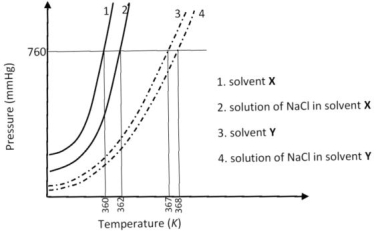
The plot given below shows $P - T$ curves (where $P$ is the pressure and $T$ is the temperature) for two solvents $X$ and $Y$ and isomolal solutions of $NaCl$ in these solvents. $NaCl$ completely dissociates in both the solvents.

On addition of equal number of moles of a non-volatile solute $S$ in equal amount (in $kg$ ) of these solvents, the elevation of boiling point of solvent $X$ is three times that of solvent $Y$. Solute $S$ is known to undergo dimerization in these solvents. If the degree of dimerization is $0.7$ in solvent $Y$, the degree of dimerization in solvent $X$ is. . . . . . .

Compound which gives acetone on ozonolysis
Benzotrichloride reacts with milk of lime to form
Which of the following sequence is correct with reference to the oxidation number of iodine
$50\, ml$ of $0.2\, M$ solution of a compound with empirical formula $CoCl_3.4\,NH_3$ on treatment with excess of $AgNO_3(aq)$ yields $1.435\, g$ of $AgCl.$ Ammonia is not removed by treatment with concentrated $H_2SO_4.$ The formula of the compound is :
Zeigler - Natta catalyst is used for which type of reaction
The Wurtz-Fittig reaction involves condensation of
For a reaction, $X(g) \to Y(g) + Z(g)$ the half life period is $ 10\,\min$. In What period of time would the concentration of $X$ be reduced to $ 10\%$ of original concentration ........... $\min$