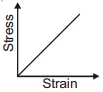
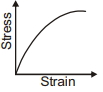
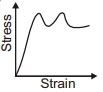
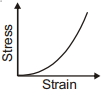
Which of the following is the graph showing stress-strain variation for elastomers?
- A
- B
- C

- D
Easy


Download our appand get started for free
Experience the future of education. Simply download our apps or reach out to us for more information. Let's shape the future of learning together!No signup needed.*
Similar Questions
- 1$Assertion :$ Hollow shaft is found to be stronger than a solid shaft made of same equal material.View Solution
$Reason :$ Torque required to produce a given twist in hollow cylinder is greater than that required to twist a solid cylinder of same length and material. - 2A block of mass $M$ is suspended from a wire of length $L$, area of cross-section $A$ and Young's modulus $Y$. The elastic potential energy stored in the wire isView Solution
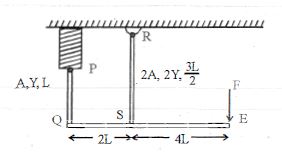
- 3A rigid massless rod of length $6\ L$ is suspended horizontally by means of two elasticrods $PQ$ and $RS$ as given figure. Their area of cross section, young's modulus and lengths are mentioned in figure. Find deflection of end $S$ in equilibrium state. Free end of rigid rod is pushed down by a constant force . $A$ is area of cross section, $Y$ is young's modulus of elasticityView Solution
- 4Young's modulus is determined by the equation given by $\mathrm{Y}=49000 \frac{\mathrm{m}}{\ell} \frac{\text { dyne }}{\mathrm{cm}^2}$ where $\mathrm{M}$ is the mass and $\ell$ is the extension of wre used in the experiment. Now error in Young modules $(\mathrm{Y})$ is estimated by taking data from $M-\ell$ plot in graph paper. The smallest scale divisions are $5 \mathrm{~g}$ and $0.02$ $\mathrm{cm}$ along load axis and extension axis respectively. If the value of $M$ and $\ell$ are $500 \mathrm{~g}$ and $2 \mathrm{~cm}$ respectively then percentage error of $\mathrm{Y}$ is :View Solution
- 5A bar is subjected to axial forces as shown. If $E$ is the modulus of elasticity of the bar and $A$ is its crosssection area. Its elongation will beView Solution

- 6When a certain weight is suspended from a long uniform wire, its length increases by one $cm$. If the same weight is suspended from another wire of the same material and length but having a diameter half of the first one, the increase in length will be ......... $cm$View Solution
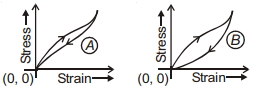
- 7View SolutionTwo different types of rubber are found to have the stress-strain curves as shown. Then
- 8A vertical hanging bar of length $l$ and mass $m$ per unit length carries a load of mass $M$ at lower end, its upper end is clamped to a rigid support. The tensile stress a distance $x$ from support is $(A \rightarrow$ area of cross-section of bar)View Solution
- 9View SolutionModulus of rigidity of a liquid
- 10A force $F$ is applied on a square area of side $L$. If the percentage error in the measurement of $L$ is $2 \%$ and that in $F$ is $4 \%$, what is the maximum percentage error in pressure?View Solution