Which of the following is the incorrect graph for a sphere falling in a viscous liquid? (Given at $t = 0$, velocity $v = 0$ and displacement $x = 0$.)
Diffcult
Download our app for free and get started
A sphere falling in a viscous liquid increases its speed with time and finally achieves a terminal velocity at infinite time.
velocity varies with time as shown.
Net acceleration of the sphere is ($m g-$ Buoyant force$-$Viscous Force) downwards
$a=d \frac{4}{3} \pi R^{3} g-\rho \frac{4}{3} \pi R^{3} g-6 \pi \eta R v$
Hence a varies linearly with velocity. Hence option $\mathrm{C}$ is the correct answer.

Download our appand get started for free
Experience the future of education. Simply download our apps or reach out to us for more information. Let's shape the future of learning together!No signup needed.*
Similar Questions
- 1A solid sphere of specific gravity $27$ has a concentric spherical cavity and it just sinks in water. The ratio of cavity radius to that of outer radius of sphere isView Solution
- 2The two thigh bones (femures), each of cross-sectional area $10 \,cm ^2$ support the upper part of a person of mass $50 \,kg$. The average pressure sustained by the femures is ............. $N / m ^2$View Solution
- 3Two capillary of length $L $ and $2L$ and of radius $R$ and $2R$ are connected in series. The net rate of flow of fluid through them will be (given rate of the flow through single capillary, $X = \pi P{R^4}/8\eta L)$View Solution
- 4The velocity of a small ball of mass $\mathrm{M}$ and density $d,$ when dropped in a container filled with glycerine becomes constant after some time. If the density of glycerine is $\frac{\mathrm{d}}{2}$, then the viscous force acting on the ball will be :View Solution
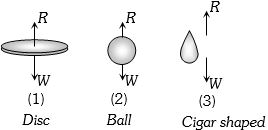
- 5When a body falls in air, the resistance of air depends to a great extent on the shape of the body, $ 3 $ different shapes are given. Identify the combination of air resistances which truly represents the physical situation. (The cross sectional areas are the same).View Solution
- 6The density of the atmosphere at sea level is $1.29 \;kg / m ^{3} .$ Assume that it does not change with altitude. Then how high (in $km$) would the atmosphere extend?View Solution
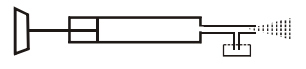
- 7A spray gun is shown in the figure where a piston pushes air out of a nozzle. A thin tube of uniform cross section is connected to the nozzle. The other end of the tube is in a small liquid container. As the piston pushes air through the nozzle, the liquid from the container rises into the nozzle and is sprayed out. For the spray gun shown, the radii of the piston and the nozzle are $20 \ mm$ and $1 \ mm$ respectively. The upper end of the container is open to the atmosphere. $Image$View Solution
$1.$ If the piston is pushed at a speed of $5 \ mms ^{-1}$, the air comes out of the nozzle with a speed of
$(A)$ $0.1 \ ms ^{-1}$ $(B)$ $1 \ ms ^{-1}$ $(C)$ $2 \ ms ^{-1}$ $(D)$ $8 \ ms ^{-1}$
$2.$ If the density of air is $\rho_{ a }$ and that of the liquid $\rho_{\ell}$, then for a given piston speed the rate (volume per unit time) at which the liquid is sprayed will be proportional to
$(A)$ $\sqrt{\frac{\rho_{ a }}{\rho_{\ell}}}$ $(B)$ $\sqrt{\rho_a \rho_{\ell}}$ $(C)$ $\sqrt{\frac{\rho_{\ell}}{\rho_{ a }}}$ $(D)$ $\rho_{\ell}$
Give the answer question $1$ and $2.$
- 8Different processes are given in Column - $\mathrm{I}$ and its reasons are given in Column - $\mathrm{II}$. Match the appropriately.View Solution
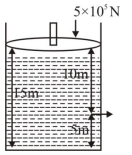
Column - $\mathrm{I}$ Column - $\mathrm{II}$ $(a)$Rain drops moves downwards with constant velocity. $(i)$ Viscous liquids $(b)$ Floating clouds at a height in air. $(ii)$ Viscosity $(iiii)$ Less density - 9Consider a cylindrical tank of radius $1 m$ is filled with water. The top surface of water is at $15\,m$ from the bottom of the cylinder. There is a hole on the wall of cylinder at a height of $5\,m$ from the bottom. A force of $5 \times 10^{5} N$ is applied an the top surface of water using a piston. The speed of efflux from the hole will be.View Solution
(given atmospheric pressure $P_{A}=1.01 \times 10^{5}\,Pa$, density of water $\rho_{ w }=1000\,kg / m ^{3}$ and gravitational acceleration $g=10\,m / s ^{2}$ )
- 10The bulk modulus of a liquid is $3 \times 10^{10}\, Nm ^{-2}$. The pressure required to reduce the volume of liquid by $2 \%$ is ........ $\times 10^{8}\; Nm ^{-2}$View Solution