MCQ
Which of the following is the weakest acid
  • $HF$
  • B
    $HCl$
  • C
    $HBr$
  • D
    $HI$

Answer

Correct option: A.
$HF$
a
(a) $HF$ is the weakest acid. Since it is unable to give ${H^ + }$ ions which are trapped in $H$ - Bonding.

Need a full question paper?

Generate a complete, print-ready paper with questions like this in minutes — across 16+ boards, with answer keys.

Start Generating Free

Similar questions

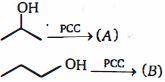
$(A)$ and $(B)$ is differentiated by
Which one is incorrect :
Which of the following ions does not liberate hydrogen gas on reaction with dilute acids ?
$\begin{matrix}
   O\,\,\,\,\,\,\,\,\,\,\,\,\,\,\,\,\,\,\,\,\,\,\,\,\,\,\,\,\,\,\,\,\,\,\,\,\,\,\,\,\,\,\,\,\,\,\,\,\,\,\,\,\,\,\,\,\,\,\,\,\,\,\,\,\,\,\,\,\,\,\,\,\,\,\,\,\,\,\,\,\,\,\,\,O\,\,\,\,\,\,\,\,\,\,\,\,\,\,\,\,\,\,\,\,\,\,\,\,\,  \\
   ||\,\,\,\,\,\,\,\,\,\,\,\,\,\,\,\,\,\,\,\,\,\,\,\,\,\,\,\,\,\,\,\,\,\,\,\,\,\,\,\,\,\,\,\,\,\,\,\,\,\,\,\,\,\,\,\,\,\,\,\,\,\,\,\,\,\,\,\,\,\,\,\,\,\,\,\,\,\,\,\,\,\,\,\,\,\,||\,\,\,\,\,\,\,\,\,\,\,\,\,\,\,\,\,\,\,\,\,\,\,\,\,  \\
   C{{H}_{3}}-C-C{{H}_{2}}-C{{H}_{2}}-C{{H}_{2}}-C{{H}_{2}}-C-H\xrightarrow{H{{O}^{-}}/\Delta }\underset{(73\%)}{\mathop{(A)}}\,;  \\
\end{matrix}$ Product $(A)$ is
The number of unpaired electrons in cobalt atom is (atomic number of $Co = 27$)
Which one of the following is the weakest base?
At $100\,^oC,$ the gaseous reaction $A \rightarrow 2B + C$ is found to be first order. Starting with pure $A,$ if at the end of $10\,\min$, the total pressure of the system is $160\, mm$ and after a long time, when dissociation of $A$ was complete, it was $300\, mm.$ The partial pressure of $A$ at the end of $10\,\min$ is .......... $mm$
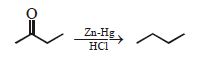
The above reaction is
The reaction of white phosphorous with aqueous $NaOH$ gives phosphine along with another phosphorus containing compound. The reaction type; the oxidation states of phosphorous in phosphine and the other product are respectively
Many of the actual sites of an enzyme contain metal ions that enhance reaction particularly by helping to bind the substrate or to withdraw electrons is called as: