MCQ
Which of the following is unitless quantity ?
  • A
    Velocity gradient
  • B
    Pressure gradient
  • Displacement gradient
  • D
    Force gradient

Answer

Correct option: C.
Displacement gradient
c
Gradient of a quantity $Q$ is given as $\frac{\Delta Q}{\Delta x}$

Thus, a gradient will be unitless if its numerator has same dimensions as denominator, i.e. $x$ (which has the dimension $L$ ).

Thus, out of the options, Displacement has the dimension $L$ and hence its gradient will be dimensionless.

Need a full question paper?

Generate a complete, print-ready paper with questions like this in minutes — across 16+ boards, with answer keys.
Start Generating Free

Similar questions

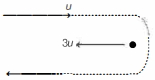
A spacecraft which is moving with a speed $u$ relative to the earth in the $x$-direction, enters the gravitational field of a much more massive planet which is moving with a speed $3 \,u$ in the negative $x$-direction. The spacecraft exits following the trajectory as shown below. The speed of the spacecraft with respect to the earth a long a time after it has escaped the planet's gravity is given by
A particle is acted upon by a force of constant magnitude which is always perpendicular to the velocity of the particle. The motion of the particle takes place in a plane. It follows that:
Number of degrees present in one radian is
A particle moves in the $xy$ -plane with velocity $u_x = 8t -2$ and $u_y = 2$. If it passes through  the point $(14, 4)$ at $t = 2\, s$, the equation of its path is 
The maximum potential energy of a block executing simple harmonic motion is $25\,J$. A is amplitude of oscillation. At $A / 2$, the kinetic energy of the block is $...............$
Two particles $A$ and $B$ are projected simultaneously from a fixed point of the ground. Particle $A$ is projected on a smooth horizontal surface with speed $v$, while particle $B$ is projected in air with speed $\frac{2 v}{\sqrt{3}}$. If particle $B$ hits the particle $A$, the angle of projection of $B$ with the vertical is
A particle is projected from the ground with velocity $u$ at angle $\theta$ with horizontal. The horizontal range, maximum height and time of flight are $R, H$ and $T$ respectively. They are given by $R = \frac{{{u^2}\sin 2\theta }}{g}$, $H = \frac{{{u^2}{{\sin }^2}\theta }}{{2g}}$ and $T = \frac{{2u\sin \theta }}{g}$  Now keeping $u $ as fixed, $\theta$ is varied from $30^o$ to $60^o$. Then,
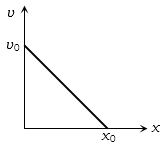
The given graph shows the variation of velocity with displacement. Which one of the graph given below correctly represents the variation of acceleration with displacement
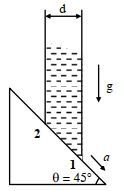
A cylindrical tube, with its base as shown in the figure, is filled with water. It is moving down with a constant acceleration $a$ along a fixed inclined plane with angle $\theta=45^{\circ} . P_1$ and $P_2$ are pressures at points 1 and 2 , respectively, located at the base of the tube. Let $\beta=\left(P_1-P_2\right) /(\rho g d)$, where $\rho$ is density of water, $d$ is the inner diameter of the tube and $g$ is the acceleration due to gravity. Which of the following statement($s$) is(are) correct?

$(A)$ $\beta=0$ when $a= g / \sqrt{2}$

$(B)$ $\beta>0$ when $a= g / \sqrt{2}$

$(C)$ $\beta=\frac{\sqrt{2}-1}{\sqrt{2}}$ when $a= g / 2$

$(D)$ $\beta=\frac{1}{\sqrt{2}}$ when $a= g / 2$
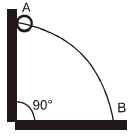
A wire, which passes through the hole is a small bead, is bent in the form of quarter of a circle. The wire is fixed vertically on ground as shown in the figure. The bead is released from near the top of the wire and it slides along the wire without friction. As the bead moves from $A$ to $B$, the force it applies on the wire is