MCQ
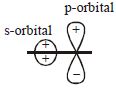
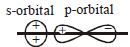
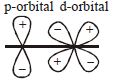
Which of the following leads to bonding ?
  • A


  • C

  • D

Answer

Correct option: B.

b
Same sign phase leads to bonding and oppoite will lead to anti-bonding.

So, optiom $(B)$ has bonding orbitas and others have auti-bonding.

Need a full question paper?

Generate a complete, print-ready paper with questions like this in minutes — across 16+ boards, with answer keys.

Start Generating Free

Similar questions

Among given species identify the isostructural pairs
Phenol dimerised to $60\%$ in a solvent. The observed molecular weight of phenol will be
Which of the following electronic configurations in the outermost shell is characteristic of alkali metals
Which of the following $3d$ bivalent metal ions has the smallest number of unpaired $d$ electrons
Match List $I$ with List $II$

List $I$ Vitamin List $II$ Deficiency disease
$A$ Vitamin $A$ $I.$ Beri-Beri
$B$ Thiamine $II.$ Cheilosis
$C$ Ascorbic acid $III.$ Xeropthalmia
$D$ Riboflavin $IV.$ Scurvy

Choose the correct answer from the options given below:

Calculate the half life of the first-order reaction

$C_2H_4O(g) \longrightarrow CH_4(g) + CO(g)$ If the initial pressure of $C_2H_4O(g)$ is $80\, mm$ and total pressure at the end of $20\, minutes$ is $120\, mm$ ............ $\min$

Select equations having endothermic step

$(A)\,S_{\left( g \right)}^ - \,\, \to \,\,S_{\left( g \right)}^{2 - }\,$

$(B)\,Na_{\left( g \right)}^ + \, + \,Cl_{\left( g \right)}^ - \,\, \to \,\,NaCl\,(s)$

$(C)\,{N_{\left( g \right)}}\, \to \,\,N_{\left( g \right)}^ - $

$(D)\,Al_{\left( g \right)}^{2 + }\, \to \,\,Al_{\left( g \right)}^{3 + }$

The energies of activation for forward and reverse reactions for ${A_2} + {B_2} \rightleftharpoons 2AB$ are $180\, kJ\, mol^{-1}$ and $200\, kJ\, mol^{-1}$ respectively. The presence of a catalyst lowers the activation energy of both (forward and reverse) reactions by $100\, kJ\, mol^{-1}$. The enthalpy change of the reaction $(A_2 + B_2 \to  2AB)$ in the presence of catalyst will be (in $kJ\, mol^{-1}$)
Elements upto atomic number $103$  have been synthesized and studied. If a newly discovered element is found to have an atomic number $106,$  its electronic configuration will be
Which of the following compounds produces an optically inactive compound on hydrogenation $?$