MCQ
Which of the following metal oxide is not amphoteric
  • $Fe_2O_3$
  • B
    $Pb_3O_4$
  • C
    $Mn_2O_3$
  • D
    $Sb_2O_3$

Answer

Correct option: A.
$Fe_2O_3$
a

Need a full question paper?

Generate a complete, print-ready paper with questions like this in minutes — across 16+ boards, with answer keys.
Start Generating Free

Similar questions

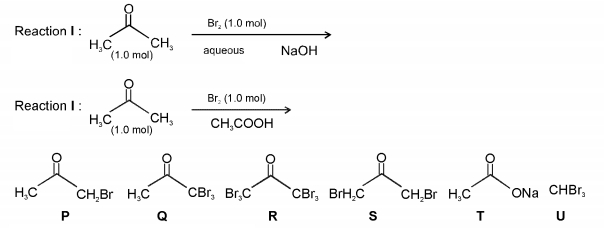
After completion of the reactions ($I$ and $II$ ), the organic compound$(s)$ in the reaction mixtures is (are)
Consider the Galvanic cell $\,Z{n^\Theta }|ZnS{O_4}||CuS{O_4}|C{u^ \oplus }$ the reaction at cathode is
$50\, mL$ of $0.1\, M$ solution of a salt reacted with $25\, mL$ of $0.1\, M$ solution of sodium sulphite. The half reaction for the oxidation of sulphite ion is

$SO{{_{3}^{2-}}_{\left( aq. \right)}}+{{H}_{2}}{{O}_{\left( l \right)}}\to SO{{_{4}^{2-}}_{\left( aq. \right)}}+2{{H}^{+}}_{\left( aq. \right)}+2{{H}^{+}}_{\left( aq. \right)}+2{{e}^{-}}$

If the oxidation number of metal in the salt was $+3$, what would be the new oxidation number of metal?

Which of the following compounds is not chiral
In the given reaction :

$CH_3-COOH$ $\mathop {\xrightarrow{{(i)\,B{r_2}/P}}}\limits_{(ii)\,NaCN\,(iii)\,{H_2}O/{H^ \oplus }/\Delta } \,[X]$

$[X]$ will be :

Element having highest $I.P.$ value is
Which one of the following is not a transition metal
Match complex ion (in List $I$) with number of unpaired electrons (in List $II$)

  List-$I$   List-$II$
$A$ $[Fe(H_2O)_6]^{2+}$ $P$ $0$
$B$ $[Fe(H_2O)_6]^{3+}$ $Q$ $1$
$C$ $[Fe(CN)_6]^{4-}$ $R$ $2$
$D$ $[Fe(CN)_6]^{3-}$ $S$ $4$
$E$ $[Ni(H_2O)_4]^{2+}$ $T$ $5$

$A$   $||$   $B$  $||$   $C$  $||$   $D$   $||$  $E$

The ground state energy of hydrogen atom is $-13.6 eV$. Consider an electronic state $\Psi$ of $He ^{-}$whose energy, azimuthal quantum number and magnetic quantum number are $-3.4 eV , 2$ and $0$ respectively. Which of the following statement($s$) is(are) true for the state $\Psi$ ?

$(1)$ It has $2$ angular nodes

$(2)$ It has $3$ radial nodes

$(3)$ It is a 4d state

$(4)$ The nuclear charge experienced by the electron in this state is less than $2 e$, where $e$ is the magnitude of the electronic charge.

The following equilibrium exists in aqueous solution $C{H_3}COOH$ $\rightleftharpoons$ $C{H_3}CO{O^ - } + {H^ + }$. If dilute $HCl$ is added without a change in temperature, then the