MCQ
Which of the following $M.O$ has two nodal Plane's
- ✓${\sigma _{2s}}$
- B${\pi _{2{p_y}}}$
- C${\pi ^ * }_{2{p_y}}$
- D${\sigma ^ * }_{2{p_z}}$
Similar overlapping of $p_y$ orbitals take place.
Therefore, $\pi^* 2 p _{ y }$ antibonding molecular orbital has two nodal planes.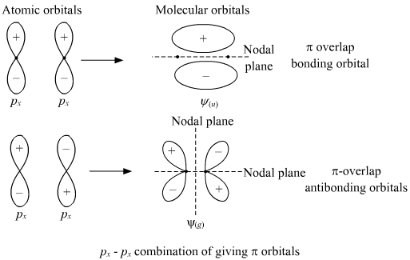
Generate a complete, print-ready paper with questions like this in minutes — across 16+ boards, with answer keys.
$A\left( s \right) \rightleftharpoons B\left( g \right) + C\left( g \right);{K_{{p_1}}} = x\,at{m^2}$
$D\left( s \right) \rightleftharpoons C\left( g \right) + E\left( g \right);{K_{{p_2}}} = y\,at{m^2}$
The total pressure when both the solids dissociate simultaneously is
$xBrO_3\,^-+ yCr^{+3} + zH_2O \to Br_2 + CrO_4 ^{-2} + H^+$
the coefficients $x, y, z$ are