MCQ
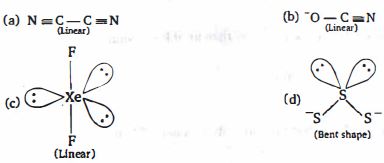
Which of the following molecular species is not linear ?
  • A
    $(CN)_2$
  • B
    $OCN^-$
  • C
    $XeF_2$
  • $S^{2-}_3$

Answer

Correct option: D.
$S^{2-}_3$
d

Need a full question paper?

Generate a complete, print-ready paper with questions like this in minutes — across 16+ boards, with answer keys.

Start Generating Free

Similar questions

A compound $MX_2$ has observed and normal molecular masses $65.6$ and $164$ respectively. Calculate percentage of ionization of $MX_2$ ............ $\%$
Given below are two statements :
Statement (I) : Kjeldahl method is applicable to estimate nitrogen in pyridine.
Statement (II) : The nitrogen present in pyridine can easily be converted into ammonium sulphate in Kjeldahl method.
In the light of the above statements, choose the correct answer from the options given below.
The equilibrium constant for the reaction ${N_{2(g)}} + {O_{2(g)}}$ $\rightleftharpoons$ $2N{O_{(g)}}$ at temperature $T$ is $4 \times {10^{ - 4}}$. The value of ${K_c}$ for the reaction $N{O_{(g)}}$ $\rightleftharpoons$ $\frac{1}{2}{N_{2(g)}} + \frac{1}{2}{O_{2(g)}}$ at the same temperature is
Assertion : Amines are basic in nature
Reason : Presence of lone pair of electrons on nitrogen atom
$(i)$ chlorobenzene is mono-nitrated to $M$
$(ii)$ nitrobenezene is mono-chlorinated to $N$
$(iii)$ anisole is mono-nitrated to $P$
$(iv)\, 2-$ nitrochlorobenzene is mono-nitrated to $Q.$
Out of $M, N, P$ and $Q$ the compound that undergoes reaction with $aq. NaOH$ fastest is
For a reactions $A + B \to $product, it was found that rate of reaction increases four times if concentration of $ ‘A’$  is doubled, but the rate of reaction remains unaffected. If concentration of $‘B’ $ is doubled. Hence, the rate law for the reaction is
The $IUPAC$ name of the compound
Which of the following alkyl groups has the maximum $+ I$ effect
In the following reaction; $xA \longrightarrow yB$

${\log _{10}}\,\left[ { - \frac{{d\left[ A \right]}}{{dt}}} \right] = {\log _{10}}\,\left[ {\frac{{d\left[ B \right]}}{{dt}}} \right] + 0.3010$

$‘A’$ and $‘B’$ respectively can be

Which one of the following compounds has non zero dipole moment?