MCQ
Which of the following molecules is/are chiral ?
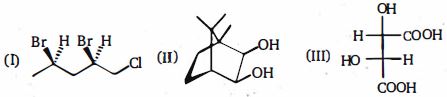
  • A
    $I$
  • B
    $II$
  • C
    $III$
  • $I,II$

Answer

Correct option: D.
$I,II$
d
$(d)$ Compound which do not have plane and centre of symmetry are optically  active.

Need a full question paper?

Generate a complete, print-ready paper with questions like this in minutes — across 16+ boards, with answer keys.

Start Generating Free

Similar questions

When first ionisation energy is plotted against the atomic number, the peaks in curve are occupied by
The decreasing order of nucleophilicity among
the following nucleophiles is :

$(I)$ $CH_3COO^{\Theta}$          $(II)$ $CH_3O^{\Theta}$ 

$(III)$ $CH_3CH_2^{\Theta}$        $(IV)$ $CH_3SO_3^{\Theta}$

An aqueous solution ox $X$ is added slowly to an aqueous solution of $Y$ as shown in list $I$. The variation in conductivity of these reactions is given in List $II$. Match List $I$ with List $II$ and select the correct answer using the code given below the lists :

List $I$ List $II$
$P$. $\quad \underset{X}{\left( C _2 H _5\right)_3 N }+\underset{ Y }{ CH _3 COOH }$ $1.$ Conductivity decreases and then increases
$Q.$ $\quad \underset{X}{ KI (0.1 M )}+\underset{ Y }{ AgNO _3(0.01 M )}$ $2.$ Conductivity decreases and then does not change much
$R.$ $\quad \underset{X}{ CH _3 COOH }+\underset{ K }{ KOH }$ $3.$ Conductivity increases and then does not change much
$S$. $\quad \underset{X}{ NaOH }+\underset{Y}{ HI }$ $4.$ Conductivity does not change much and then increases

Codes: $ \quad P \quad Q \quad R \quad S $ 

Which of the following compound undergoes disproportionation in presence of $SO_3$ gas ?
For electron gain enthalpies of the elements denoted as $\Delta_{ eg } H$, the incorrect option is :
Number of sigma bonds in ${P_4}{O_{10}}$ is
Which one of the following is a different pair?
$S—O$ bond length is maximum in
In which of the following, functional group isomerism is not possible?
$XeF_2$ is isostructural with