MCQ
Which of the following number of lone pair at central atom zero

$XeO _{3}, XeO _{2} F _{2}, XeO _{4}, XeO _{3} F _{2}, Ba _{2} XeF _{4}$

  • $2$
  • B
    $3$
  • C
    $4$
  • D
    zero

Answer

Correct option: A.
$2$
a
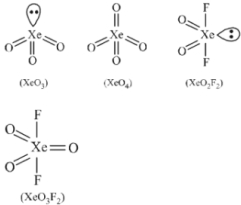
The geometries of the given compounds are shown below.

Among the above shown compounds $XeO _{4},$ and $XeO _{3} F _{2}$ do not have lone pairs of electrons.
Need a full question paper?

Generate a complete, print-ready paper with questions like this in minutes — across 16+ boards, with answer keys.
Start Generating Free

Similar questions

At $298\, \mathrm{~K}$, the enthalpy of fusion of a solid $(\mathrm{X})$ is $2.8 \,\mathrm{k} \mathrm{J}\, \mathrm{mol}^{-1}$ and the enthalpy of vaporisation of the liquid $(X)$ is $98.2 \,\mathrm{~kJ}\, \mathrm{~mol}^{-1}$. The enthalpy of sublimation of the substance $(\mathrm{X})$ in $\mathrm{kJ} \,\mathrm{mol}^{-1}$ is $.....$ (in nearest integer)
$60 \,g$ of a compound on analysis gave $C = 24\,{\rm{ }}g,$ $H = 4\,{\rm{ }}g$ and $O = 32\, g$. Its Empirical formula is
Which is least soluble in water
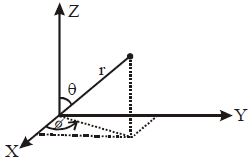
Angular wave function $A(\theta , \phi )$ for any atomic orbital is " $\frac{1}{2}\sqrt {\frac{3}{\pi }\cos \theta }$ " in polar co-ordinate system
For a reaction at equilibrium

$A ( g ) \rightleftharpoons B ( g )+\frac{1}{2} C ( g )$

the relation between dissociation constant ( $K$ ), degree of dissociation $(\alpha)$ and equilibrium pressure $(p)$ is given by?

Which of the following bonds require the largest amount of bond energy to dissociate the atom concerned
For the reversible reaction in equilibrium

${N_2}\left( g \right) + {O_2}\left( g \right)\underset{{{k_2}}}{\overset{{{k_1}}}{\longleftrightarrow}}2NO\left( g \right)$

$C_0 = Ce^{-2.1×10^{-3}\ t}$ for the forward reaction and

$C_0'= C'e^{-4.2×10^{-4}\ t}$ for the backward reaction, hence $K_c$ for the above equilibrium is
All members of a homologous series differ by a :
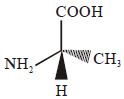
Configuration of given compound is
The chemical behaviour and relative inertness of dihydrogen at room temperature depends upon: