MCQ
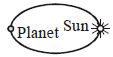
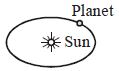
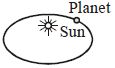
Which of the following orbits is a possible orbit for a planet ?
  • A

  • B

  • C


Answer

Correct option: D.

d
Sun must be at one focus, which location is inside away from centre and symmetric option $(4).$

Need a full question paper?

Generate a complete, print-ready paper with questions like this in minutes — across 16+ boards, with answer keys.
Start Generating Free

Similar questions

Two small spherical metal balls, having equal masses, are made from materials of densities $\rho_{1}$ and $\rho_{2}\left(\rho_{1}=8 \rho_{2}\right)$ and have radii of $1\; \mathrm{mm}$ and $2\; \mathrm{mm}$, respectively. They are made to fall vertically (from rest) in a viscous medum whose coefficient of viscosity equals $\eta$ and whose denstry is $0.1 \mathrm{\rho}_{2} .$ The ratio of their terminal velocitites would be 
A sphere is suspended by a thread of length $l$. What minimum horizontal velocity has to be imparted the ball for it to reach the height of the suspension
The expression $[M{L^2}{T^{ - 2}}]$ represents
A ball $'A'$ of mass $m$ falls to the surface of the earth from infinity. Another ball $'B'$ of mass $2m$ falls to the earth from the height equal to six times radius of the earth then ratio of velocities of $'A'$ and $'B'$ on reaching the earth is
A ball is travelling with uniform translatory motion. This means that:
  1. It is at rest.
  2. The path can be a straight line or circular and the ball travels with uniform speed.
  3. All parts of the ball have the same velocity (magnitude and direction) and the velocity is constant.
  4. The centre of the ball moves with constant velocity and the ball spins about its centre uniformly.
For a gas, the difference between the two specific heats is $4150\, J\, kg^{-1}\, K^{-1}$ and the ratio of the two specific heats is $1.4$. What is the specific heat of the gas at constant volume in units of $J\, kg^{-1}\, K^{-1}$ ?
It is estimated that per minute each $cm^2$ of earth receives about $2\ cal (1\ cal = 4.18\ J)$ of heat energy from the sun. This is called Solar constant. In $SI$ units the value is :-
In traslational equilibrium:
Two coherent sources of different intensities send waves which interfere. The ratio of maximum intensity to the minimum intensity is 25. The intensities of the sources are in the ratio:
  1. 25 : 1
  2. 5 : 1
  3. 9 : 4
  4. 625 : 1
A ball is thrown upwards and it returns to ground describing a parabolic path. Which of the following remains constant