- AElectronegativity of central atom : $CF_4 > CH_4 > SiH_4$
- ✓Hydration energy : $Al^{3+} > Be^{2+} > Mg^{2+} > Na^+$
- CElectrical conductance : $F^-_{(aq.)} > Cl^-_{(aq.)} > S^{2-}_{(aq.)}$
- DMagnetic moment : $Ni^{4+} > V^{3+} > Sr^{2+}$
$Na _{2} O \quad$ Basic
$Al _{2} O _{3} \quad$ Amphoteric
$N _{2} O \quad$ Neutral
Generate a complete, print-ready paper with questions like this in minutes — across 16+ boards, with answer keys.
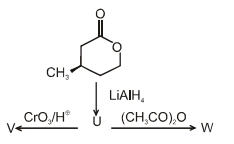
$(A)$ $T$ is soluble in hot aqueous $NaOH$
$(B)$ $U$ is optically active
$(C)$ Molecular formula of $W$ is $C _{10} H _{18} O _4$
$(D)$ $V$ gives effervescence on treatment with aqueous $NaHCO _3$
$20 \;g \;\;\;\;5 \;g$
Consider the above reaction, the limiting reagent of the reaction and number of moles of $NH _{3}$ formed respectively are
$(i)\,CH_3CH_2OH$
$(ii)\ CH_3COCH_3$
$(iii)\ \begin{array}{*{20}{c}}
{C{H_3} - CHOH} \\
{\,\,|} \\
{\,\,\,\,\,\,C{H_3}}
\end{array}$
$(iv) \,CH_3OH$
Which of the above compound(s), on being warmed with iodine solution and $NaOH,$ will give iodoform ?