MCQ
Which of the following order is incorrect
  • A
    Ionic character $ \Rightarrow  MCl < MCl_2 < MCl_3$
  • B
    Polarizibility $ \Rightarrow F^-< Cl^-< Br^-< I^-$
  • Polarising power $ \Rightarrow Ca^{+2} < Mg^{+2} < Al^{+3}$
  • D
    Covalent character $ \Rightarrow LiF < LiCl < LiBr < LiI$
Answer

Correct option: C.
Polarising power $ \Rightarrow Ca^{+2} < Mg^{+2} < Al^{+3}$
c
Order of electron gain enthalpy

(Absolute value)

$Cl > F > Br > I$

Need a full question paper?

Generate a complete, print-ready paper with questions like this in minutes — across 16+ boards, with answer keys.

Start Generating Free

Similar questions

The transition element that has lowest enthalpy of atomisation is
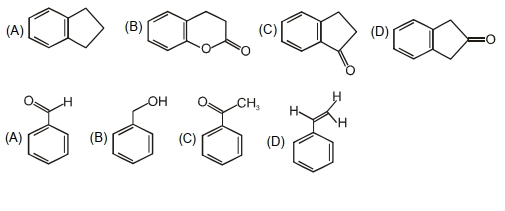
In the following reactions sequence, the compound $J$ is an intermediate.

$I \frac{\left( CH _3 CO \right)_2 O }{ CH _3 COONa } J \xrightarrow[\begin{array}{l}\text { (ii) } SOCl _2 \\ \text { (ii) anhyd. } AlCl _3\end{array}]{\text { (i) } H _2, Pd / C } K$

$J \left( C _9 H _8 O _2\right)$ gives effervescence on treatment with $NaHCO _3$ and positive Baeyer's test

$1.$ The compound $K$ is

mcq $Image$

$2.$ The compound $I$ is

mcq $Image$

Give the answer question $1$ and $2.$

The pressure at which liquid and vapour can coexist at equilibrium is called the :
In the following sequence of reaction,

$Z\,\xrightarrow{{PC{l_5}}}\,X\,\xrightarrow[\Delta ]{{{\text{Alc}}{\text{.KOH}}}}\,Y\,\xrightarrow{{{H_2}O/{H^ \oplus }}}\,\mathop Z\limits_{{\text{(Major)}}} \,,\,\,Z$ is 

An aqueous solution of glucose was prepared by dissolving  $18\,g$ of glucose in $90\,g$ of water. The relative lowering in vapour pressure is
$RMgBr$ on reaction with an excess of oxygen followed by hydrolysis gives
The $\text {IUPAC}$ name for the complex $\left[ Co \left( NO _{2}\right)\left( NH _{3}\right)_{5}\right] Cl _{2}$ is :
Consider the following reactions :

$(i)$ $PCl_3 + 3H_2O \to H_3PO_3 + 3HCl$   

$(ii)$ $SF_4 + 3H_2O \to H_3SO_3 + 4HF$   

$(iii)$ $BCI_3 + 3H_2O \to H_3BO_3 + 3HCl$   

$(IV)$ $XeF_6 + 3H_2O \to XeO_3 + 6HF$

Then according to given information the incorrect statement is

The element californium belongs to a family of:
A reaction takes place in three steps with individual rate constant and activation energy as follows 

     Rate constant     Activation energy
 Step $1$        $k_1$ $E_{a1} = 180\ kJ/mol$
 Step $2$        $k_2$ $E_{a2} = 80\ kJ/mol$
 Step $3$        $k_3$ $E_{a3} = 50\ kJ/mol$

If overall rate constant, $k = {\left( {\frac{{{k_1}{k_2}}}{{{k_3}}}} \right)^{2/3}}$  ,then overall activation energy of the reaction will be  .......... $ kJ/mol$