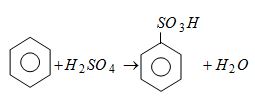
MCQ
Which of the following processes is reversible
  • A
    Halogenation
  • Sulphonation
  • C
    Nitration
  • D
    None

Answer

Correct option: B.
Sulphonation
b
(b)

Need a full question paper?

Generate a complete, print-ready paper with questions like this in minutes — across 16+ boards, with answer keys.

Start Generating Free

Similar questions

On heating, lead$(II)$ nitrate gives a brown gas $(A).$ The gas $(A)$ on cooling changes to a colourless solid/liquid $(B).$ $(B)$ on heating with $NO$ changes to a blue solid $(C).$ The oxidation number of nitrogen in solid $(C)$ is :
Type of isomerism which exists between $[Pd(C_6H_5)_2(SCN)_2]$ and $[Pd(C_6H_5)_2(NCS)_2]$ is
The ground state electronic configurations of the elements, $U, V, W, X,$ and $Y$ (these symbols do not have any chemical significance) are as follows

$U\,\,\, 1s^2 \,2s^2 \,2p^3$
$V\,\,\, 1s^2\,2s^2 \,2p^6 \,3s^1$
$W\,\,\, 1s^2\,2s^2\, 2p^6\,3s^2\,3p^2$
$X\,\,\, 1s^2\,2s^2\,2p^6\,3s^2\,3p^6\,3d^5\, 4s^2$
$Y\,\,\, 1s^2\, 2s^2\,2p^6\,3s^2\,3p^6\,3d^{10}\, 4s^2\, 4p^6$

Determine which sequence of elements satisfy the following statements :
$(i)$ Element forms a carbonate which is not decomposed by heating
$(ii)$ Element is most likely to form coloured ionic compounds
$(iii)$ Element has largest atomic radius
$(iv)$ Element forms only acidic oxide

The value of $\Delta H$ for the reaction $X_{2(g)} + 4Y_{2(g)} \rightleftharpoons XY_{4(g)}$ is less than zero. Formation of $XY_{4(g)}$ will be favoured at
The Henry's law constant $\left(\mathrm{K}_H\right)$ values of three gases $(A, B, C)$ in water are $145,2 \times 10^{-5}$ and $35$ kbar, respectively. The solubility of these gases in water follow the order:
Which orbital is dumb-bell shaped ?
$A, B$ and $C$ are hydroxy-compounds of the elements $X, Y$ and $Z$ respectively.  $X ,Y$ and $Z$ are in the same period of the periodic table. $A$ gives  an aqueous solution of $pH$ less than seven. $B$ reacts with both strong acids and strong alkalis. $C$ gives an aqueous sohuion which is strongly alkaline.
Which of the following statements is / are true ?

$I :$ The three elements are metals.

$II :$ The electro negativities decrease from $X$ to $Y$ to $Z$.

$III :$ The atomic radius decreases in the order $X, Y$ and $Z.$

$IV : X, Y$ and $Z$ could be phosphorus, aluminium and sodium respectively.

Which of the following is non-electrolyte
Electronic transition in $He^+$ ion takes from $n_2$ to $n_1$ shell such that :
$2n_2 + 3n_1 = 18,\,\,\,$  $\,\,\,2n_2 -3n_1 = 6$ 
What will be the total number of photons emitted when electrons transit to $n_1$ shell ?
The correct order of stability for the following alkoxides is