MCQ
Which of the following processes represents a gamma-decay
  • A
    $^A{X_Z} + \gamma \, \to {\,^A}{X_{Z - 1}} + a + b$
  • B
    $^A{X_Z}{ + ^1}{n_0}\, \to {\,^{A - 3}}{X_{Z - 2}} + c$
  • $^A{X_Z}\, \to {\,^A}{X_Z} + f$
  • D
    $^A{X_Z} + {e_{ - 1}}\, \to {\,^A}{X_{Z - 1}} + g$
Answer

Correct option: C.
$^A{X_Z}\, \to {\,^A}{X_Z} + f$
c
(c)In a gamma decay process. There is no change in either $A$ or $Z.$

Need a full question paper?

Generate a complete, print-ready paper with questions like this in minutes — across 16+ boards, with answer keys.

Start Generating Free

Similar questions

The electron concentration in an $n-$type semiconductor is the same as hole concentration in a $p-$type semiconductor. An external field (electric) is applied across each of them. Compare the currents in them.
Who discovered spin quantum number
A small bar magnet has a magnetic moment $1.2 \,A-m^2$. The magnetic field at a distance $ 0.1\, m $ on its axis will be : ($\mu_0 = 4\pi \times 10^{-7} \,T-m/A$)
Two positively charged spheres of masses $m_1$ and $m_2$ are suspended from a common point at the ceiling by identical insulating massless strings of length $l$. Charges on the two spheres are $q_1$ and $q_2$, respectively. At equilibrium, both strings make the same angle $\theta$ with the vertical. Then
Assume that a neutron breaks into a proton and an electron. The energy released during this process is :............$MeV$ (mass of neutron $= 1.6725 \times 10^{-27}$ $kg$ mass of proton $= 1.6725 \times 10^{-27} $ $kg$ mass of electron = $9 \times 10^{-31} $ $kg$)
At what temperature will the resistance of a copper wire become three times its value at $0\,^oC$  ................. $^oC$ (Temperature coefficient of resistance for copper = $4 × 10^{-3} \,per\, \,^oC$ )
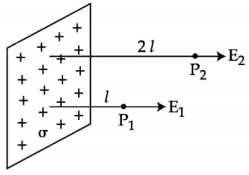
In the figure, a very large plane sheet of positive charge is shown. $P _{1}$ and $P _{2}$ are two points at distance $l$ and $2 \,l$ from the charge distribution. If $\sigma$ is the surface charge density, then the magnitude of electric fields $E_{1}$ and $E_{2}$ at $P _{1}$ and $P _{2}$ respectively are
The graph between the instantaneous concentration $(N)$ of a radioactive element and time $(t)$ is
In the product

$\overrightarrow{\mathrm{F}} =\mathrm{q}(\vec{v} \times \overrightarrow{\mathrm{B}})$

$=\mathrm{q} \vec{v} \times\left(\mathrm{B} \hat{i}+\mathrm{B} \hat{j}+\mathrm{B}_{0} \hat{k}\right)$

For $\mathrm{q}=1$ and $\vec{v}=2 \hat{i}+4 \hat{j}+6 \hat{k}$ and

$\overrightarrow{\mathrm{F}}=4 \hat{i}-20 \hat{j}+12 \hat{k}$

What will be the complete expression for $\vec{B}$ ?

Radioactive nuclei $P$ and $Q$ disintegrate into $R$ with half lives 1 month and 2 months respectively. At time $t=$ 0 , number of nuclei of each $P$ and $Q$ is $x$. Time at which rate of disintegration of $P$ and $Q$ are equal, number of nuclei of $R$ is ........ $x$