MCQ
Which of the following quantity/quantities are dependent on the choice of orientation of the co-ordinate axes?

$(a)$ $\vec{a}+\vec{b}$

$(b)$ $3 a_x+2 b_y$

$(c)$ $(\vec{a}+\vec{b}-\vec{c})$

  • Only $(b)$
  • B
    Both $(a)$ and $(b)$
  • C
    Both $(a)$ and $(c)$
  • D
    Both $(b)$ and $(c)$

Answer

Correct option: A.
Only $(b)$
a
(a)

Need a full question paper?

Generate a complete, print-ready paper with questions like this in minutes — across 16+ boards, with answer keys.

Start Generating Free

Similar questions

The upper half of an inclined plane of inclination $\theta$ is perfectly smooth while the lower half is rough. A body starting from the rest at top comes back to rest at the bottom if the coefficient of friction for the lower half is given by
The kinetic energy force on the particle continuously increases with time.
A person walks $25.0^{\circ}$ north of east for $3.18 \,km$. How far would she have to walk due north and then due east to arrive at the same location?
When a body is moving on a surface, the force of friction is called
$Assertion :$ A tube light emits white light.
$Reason :$ Emission of light in a tube takes place at a very high temperature.
A shell of mass $M$ and radius $R$ has a point mass m placed at a distance $r$ from its centre. The gravitational potential energy $U \,(r)$ vs $r$ will be
The graph between pressure $(P)$ and $\frac{1}{V}$ ($V$ is volume) for constant temperature process in ideal equation  $(PV = nRT)$
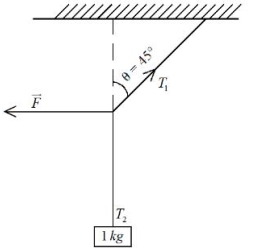
A $1 \mathrm{~kg}$ mass is suspended from the ceiling by a rope of length $4 \mathrm{~m}$. A horizontal force ' $F$ ' is applied at the mid point of the rope so that the rope makes an angle of $45^{\circ}$ with respect to the vertical axis as shown in figure. The magnitude of $F$ is:
$28\,\, gm$ of $N_2$ gas is contained in a flask at a pressure of $10$ atm and at a temperature of $57^o$. It is found that due to leakage in the flask, the pressure is reduced to half and the temperature reduced to $27\,^oC$. The quantity of $N_2$ gas that leaked out is
The value of g on the earth's surface is $980\,cm/{\sec ^2}$. Its value at a height of $64 \,km$ from the earth's surface is ........ $cm/{\sec ^2}$

(Radius of the earth $R = 6400$ kilometers)