MCQ
Which of the following ratios express pressure?
- A$\frac{\text{Force}}{\text{Area}}.$
- B$\frac{\text{Energy}}{\text{Volume}}.$
- C$\frac{\text{Energy}}{\text{Area}}.$
- D$\frac{\text{Force}}{\text{Volume}}.$
$\frac{\text{Force}}{\text{ Area}}.$
$\frac{\text{Energy}}{\text{Volume}}.$
Explanation:
Let us first express the relation of pressure with other physical quantities one by one with the help of dimensional analysis.
We know that pressure,
So, this ratio express pressure (In fact this ratio actually represents pressure).
Dimensions of this ratio are not same as pressure, so this ratio does not express pressure.
Dimensions of this ratio is the same as pressure, so this ratio also express pressure.
Dimensions of this ratio are not same as pressure, so this ratio does not express pressure.
Generate a complete, print-ready paper with questions like this in minutes — across 16+ boards, with answer keys.
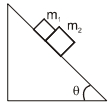
[Useful information : $\tan \left(5.5^{\circ}\right) \approx 0.1 ; \tan \left(11.5^{\circ}\right) \approx 0.2 ; \tan \left(16.5^{\circ} \approx 0.3\right)$ ]
| List $I$ | List $II$ |
| $P.\quad$ $\theta=5^{\circ}$ | $1.\quad$ $m _2 g \sin \theta$ |
| $Q.\quad$ $\theta=10^{\circ}$ | $2.\quad$ $\left(m_1+m_2\right) g \sin \theta$ |
| $R.\quad$ $\theta=15^{\circ}$ | $3.\quad$ $\mu m _2 g \cos \theta$ |
| $S.\quad$ $\theta=20^{\circ}$ | $4.\quad$ $\mu\left(m_1+m_2\right) g \cos \theta$ |