Question
Which of the following rays has the maximum frequency
|
(a) Gamma rays |
(b) Blue light |
(c) Infrared rays |
(d) Ultraviolet rays |
Which of the following rays has the maximum frequency
|
(a) Gamma rays |
(b) Blue light |
(c) Infrared rays |
(d) Ultraviolet rays |
(a) Gamma rays
Generate a complete, print-ready paper with questions like this in minutes — across 16+ boards, with answer keys.
Missing lines in a continuous spectrum reveal
|
(a) Defects of the observing instrument |
|
(b) Absence of some elements in the light source |
|
(c) Presence in the light source of hot vapours of some elements |
|
(d) Presence of cool vapours of some elements around the light source |
A 36 W galvanometer is shunted by resistance of 4W. The percentage of the total current, which passes through the galvanometer is
|
(a) 8 % |
(b) 9 % |
(c) 10 % |
(d) 91 % |
A uniform magnetic field acts at right angles to the direction of motion of electrons. As a result, the electron moves in a circular path of radius 2 cm. If the speed of the electrons is doubled, then the radius of the circular path will be
|
(a) 2.0 cm |
(b) 0.5 cm |
(c) 4.0 cm |
(d) 1.0 cm |
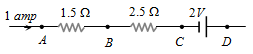
In the circuit element given here, if the potential at point B, VB = 0, then the potentials of A and D are given as
|
(a) |
(b) |
|
(c) |
(d) |
The emf of a battery is 2 V and its internal resistance is 0.5 W. The maximum power which it can deliver to any external circuit will be
|
(a) 8 Watt |
(b) 4 Watt |
(c) 2 Watt |
(d) None of the above |
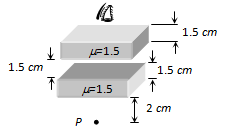
The image of point P when viewed from top of the slabs will be
|
(a) 2.0 cm above P |
(b) 1.5 cm above P |
(c) 2.0 cm below P |
(d) 1 cm above P |
A transformer is based on the principle of
|
(a) Mutual inductance |
(b) Self inductance |
|
(c) Ampere's law |
(d) Lenz's law |



