MCQ
Which of the following react with $NaHS{O_3}$
  • A
    $C{H_3}COC{H_3}$
  • B
    $C{H_3}CHO$
  • C
    $HCHO$
  • $All \,of \,these$

Answer

Correct option: D.
$All \,of \,these$
d
(d) Ketones and Aldehyde add to $NaHS{O_3}$ to give white precipitate

Need a full question paper?

Generate a complete, print-ready paper with questions like this in minutes — across 16+ boards, with answer keys.
Start Generating Free

Similar questions

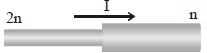
Two cylindrical rods of uniform crosssection area $A$ and $2A$, having free electrons per unit volume $2n$ and $n$ respectively are joined in series. A current $I$ flows through them in steady state. Then the ratio of drift velocity of free electron in left rod to drift velocity of electron in the right rod is $\left( {\frac{{{v_L}}}{{{v_R}}}} \right)$
A TV transmitting antenna is $98\,m$ high and the receiving antenna is at the ground level. If the radius of the earth is $6400\,km$, the surface area covered by the transmitting antenna is approximately $.........\,km^2$
Two identical conducting wires $A$ and $B$ of same dimensions and same material are bent in the form of circular coil. Wire $A$ consists of single turn whereas wire $B$ consists of $2\, turns$. Both these wires are then suspended in a uniform magnetic field with their planes parallel to the one another and same current is passed through them. Which statement is correct ?
In Young's double slit experiment, the distance between the two slits is $0.1 \,mm$ and the wavelength of light used is $4 \times {10^{ - 7}}m$. If the width of the fringe on the screen is $4\, mm$, the distance between screen and slit is
A spherical conductor of radius $10\, cm$ has a charge of $3.2 \times 10^{-7} \,C$ distributed uniformly. What is the magnitude of electric field at a point $15 \,cm$ from the centre of the sphere?

$\left(\frac{1}{4 \pi \in_{0}}=9 \times 10^{9} Nm ^{2} / C ^{2}\right)$
A cube of side $b$ has a charge $q$ at each of its vertices. The electric field due to this charge distribution at the centre of this cube will be
We have half a bucket $(6l)$ of water at $20\,^oC$  . If we want water at $40\,^oC$, how much steam at $100\,^oC$ should be added to it ?
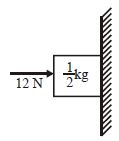
A horizontal force $12 \,N$ pushes a block weighing $1/2\, kg$ against a vertical wall.  The  coefficient of static friction between the wall and the block is $0.5$ and the coefficient of  kinetic friction is $0.35.$ Assuming that the block is not moving  initially. Which one of the following choices is correct (Take $g = 10 \,m/s^2$)
A wire of length $L$ and $3$ identical cells of negligible internal resistances are connected in series. Due to current, the temperature of the wire is raised by $\Delta T$ in a time $t$. A number $N$ of similar cells is now connected in series with a wire of the same material and cross-section but of length $2\, L$. The temperature of the wire is raised by the same amount $\Delta T$ in the same time $t$. the value of $N$ is
An $X-$ ray tube is operating at $50 kV$ and $20 mA$. The target material of the tube has a mass of $1.0 kg$ and specific heat $495 J kg-1 ^o{C^{ - 1}}$. One percent of the supplied electric power is converted into $X-$ rays and the entire remaining energy goes into heating the target. Then
