MCQ
Which of the following reactions is $S_{N_1}$ type?
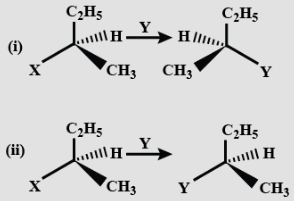
- AOnly $(i)$
- ✓Only $(ii)$
- CBoth $(i)$ and $(ii)$
- DNone of these
Generate a complete, print-ready paper with questions like this in minutes — across 16+ boards, with answer keys.
$\mathrm{CH}_{3}-\mathrm{CH}=\mathrm{CH}_{2}$ $\xrightarrow[{{\text{H}}_{2}}{{\text{O}}_{2}},\bar{O}\text{H}]{\text{B}{{\text{H}}_{3}},\text{THF}}(P)$ $\xrightarrow[\text{C}{{\text{H}}_{2}}\text{C}{{\text{l}}_{2}}]{\text{ Pyridinium Chloro Chromate }(\text{PCC})}$ $(Q)$
$\mathrm{CH}_{3}-\mathrm{CH}=\mathrm{CH}_{2}$ $\xrightarrow[NaB{{H}_{4}}\,,\,H{{O}^{\Theta }}]{Hg\,{{(OAc)}_{2}}\,,\,{{H}_{2}}O}(R)$ $\xrightarrow[\text{C}{{\text{H}}_{2}}\text{C}{{\text{l}}_{2}}]{\text{ Pyridinium Chloro Chromate }(\text{PCC})}$ $(S)$
$(1)$ Oxidation of glucose with bromine water gives glutamic acid
$(2)$ The two six-membered cyclic hemiacetal forms of $D-(+)$-glucose ard called anomers
$(3)$ Hydrolysis of sucrose gives dextrorotatory glucose and laevorotatory fructose
$(4)$ Monosaccharides cannot be hydrolysed to give polyhydroxy aldehydes and ketones
$\lambda _{O{H^ - }}^\infty$ $=200\, \ S\,cm^2 \,eq^{-1}$