MCQ
Which of the following reactions require an oxidising agent ?
- A$CH_3 -CH= CH_2 \to CH_3 -CH_2-CH_3$
- ✓$CH_3 -CH_2OH \to CH_3CHO$
- C$CH_3 -CH_2Cl \to CH_3 -CH_3$
- D$CH_3 -CH_2OH \to CH_3 -CH_2Cl$
Generate a complete, print-ready paper with questions like this in minutes — across 16+ boards, with answer keys.
$(I)$ the highest oxidation state of iron is $+ 6$ in $K_ 2FeO_4$
$(II)$ that the iron shows $+ 2$ oxidation state with six electrons in the $3d$ orbitals
$(III)$ the common oxidation state of iron is $+3$ with five unpaired electrons in $3d$ orbital
$Image$
In this reaction, $\mathrm{RCONHBr}$ is formed from which this reaction has derived its name. Electron donating group at phenyl activates the reaction. Hofmann degradation reaction is an intramolecular reaction.
$1.$ How can the conversion of $(i)$ to $(ii)$ be brought about?
$(A)$ $\mathrm{KBr}$ $(B)$ $\mathrm{KBr}+\mathrm{CH}_3 \mathrm{ONa}$ $(C)$ $\mathrm{KBr}+\mathrm{KOH}$ $(D)$ $\mathrm{Br}_2+\mathrm{KOH}$
$2.$ Which is the rate determining step in Hofmann bromamide degradation?
$(A)$ Formation of $(i)$ $(B)$ Formation of $(ii)$ $(C)$ Formation of $(iii)$ $(D)$ Formation of $(iv)$
$3.$ What are the constituent amines formed when the mixture of $(i)$ and $(ii)$ undergoes Hofmann bromamide degradation?
$Image$
give the answer question $1$, $2$, and $3.$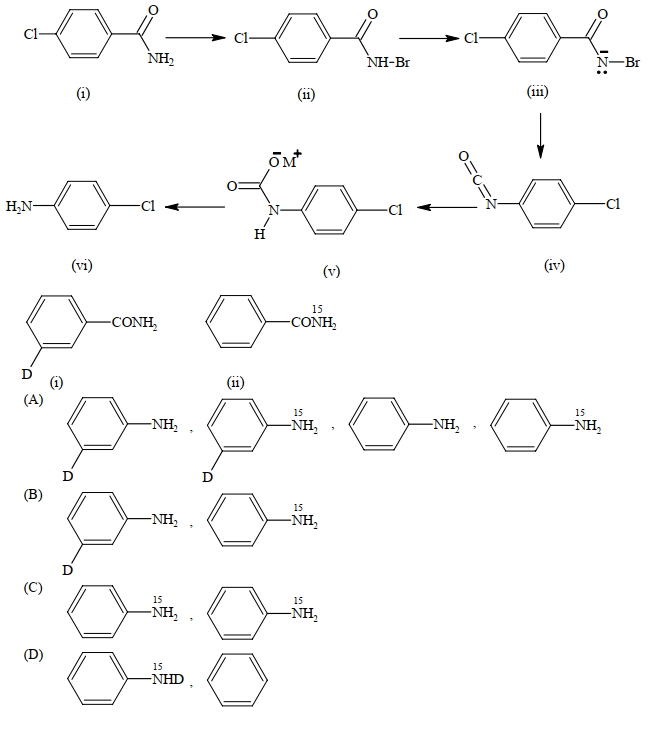
$\mathop {(A)}\limits_{{C_{11}}{H_8}O} \to $ does not under go self aldol condensation
$\mathop {(A)}\limits_{{C_{11}}{H_8}O} \xrightarrow{{{O_3}}}ph\, - \,CHO\, + \,2B\,\xrightarrow{{A{g^ + }}}$ Oxalic acid
$Xe{F_6}\,\xrightarrow{{ + {H_2}O}}A\,\xrightarrow{{ + {H_2}O}}B\,\xrightarrow{{ + {H_2}O}}C$