Which of the following reactions will NOT give primary amine as the product?
NEET 2023, Medium



Download our appand get started for free
Experience the future of education. Simply download our apps or reach out to us for more information. Let's shape the future of learning together!No signup needed.*
Similar Questions
- 1View SolutionSulphonation is most favourable at the carbon number ...

- 2Product $(C)$ of this reaction isView Solution

- 3Given below are two statements, one is labeled as Assertion $(A)$ and other is labeled as Reason $(R).$View Solution
Assertion $(A):$ Gabriel phthalimide synthesis cannot be used to prepare aromatic primary amines.
Reason $(R) :$ Aryl halides do not undergo nucleophilic substitution reaction.
In the light of the above statements, choose the correct answer form the options given below.
- 4In the chemical reaction,View Solution
$CH_3CH_2NH_2 + CHCl_3 + 3KOH \rightarrow (A)+ (B) + 3H_2O,$
the compounds $(A)$ and $(B)$ are respectively
- 5Assertion : Benzene diazonium chloride does not give test for nitrogen.View Solution
Reason : Loss of $N_2$ gas takes place during heating - 6View SolutionNitrobenzene on treatment with zinc dust and aqueous ammonium chloride gives
- 7$Z$ isView Solution
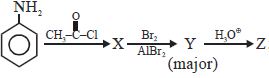
- 8View SolutionA mixture of benzene and aniline can be separated by
- 9View SolutionA primary amine can be converted to an alcohol by the action of
- 10Which one of the following reducing agents is likely to be the most effective in bringing about the following changeView Solution
$R - \mathop {\mathop {C\,N{H_2} \to RC{H_2}N{H_2}}\limits^{||\,\,\,\,\,\,\,\,\,\,\,\,\,\,\,\,\,\,\,\,\,\,\,\,\,\,\,\,\,\,\,\,\,\,\,\,\,\,\,\,\,\,\,\,\,\,\,\,\,\,\,} }\limits^{O\,\,\,\,\,\,\,\,\,\,\,\,\,\,\,\,\,\,\,\,\,\,\,\,\,\,\,\,\,\,\,\,\,\,\,\,\,\,\,\,\,\,\,\,\,\,\,\,\,} $