Question
Which of the following sequences are arithmetic progressions. For those which are arithmetic progressions, find out the common difference.
$12, 2, -8, -18, .....$

Answer

In the given problem, we are given various sequences.
We need to find out that the given sequences are an A.P. of not and then find its common difference $(d).$
$12, 2, -8, -18, .....$
Let $a_1 = 12, a_2 = 2, a_3 = -8, a_4 = -18$
Now $a_2 - a_1 = 2 - 12 = -10$
$a_3 - a_2 = -8 - 2 = -10$
$a_4 - a_3 = -18 - (-8) = -18 + 8 = -10$
$\therefore$ We see that common difference is $-10$
$\therefore$ It is an A.P.

Need a full question paper?

Generate a complete, print-ready paper with questions like this in minutes — across 16+ boards, with answer keys.
Start Generating Free

Similar questions

Find the area of both the segments of a circle of radius 42cm with central angle 120°.$$ $\Big[\text{Given }\sin120^\circ=\frac{\sqrt{3}}{2}\text{and}\sqrt{3}=1.73\Big]$
Mr. Ramesh Sawant invested ₹ 2,50,295 in shares of face value ₹ 100 each at ₹ 250 market value. He gave brokerage of 0.1 % and GST of 18 % on brokerage then how many shares are purchased by him?
A chord of a circle subtends an angle of $\theta$ at the centre of the circle. The area of the minor segment cut off by the chord is one eighth of the area of the circle. Prove that
$8\sin\frac{\theta}{2}\cos\frac{\theta}{2}+\pi=\frac{\pi\theta}{45}.$
Show graphically that the following system of equation is in-consistent (i.e. has no solution):
x - 2y = 6
3x - 6y = 0
In a class test, the sum of the marks obtained by P in Mathematics and science is $28$. Had he got $3$ marks more in mathematics and $4$ marks less in Science. The product of his marks would have been $180$. Find his marks in two subjects.
$\triangle\text{ABC}\sim\triangle\text{DEF}$ such that $\text{ar}(\triangle\text{ABC})=64\text{cm}^2$ and $\text{ar}(\triangle\text{DEF})=169\text{cm}^2.$ If BC = 4cm, find EF.
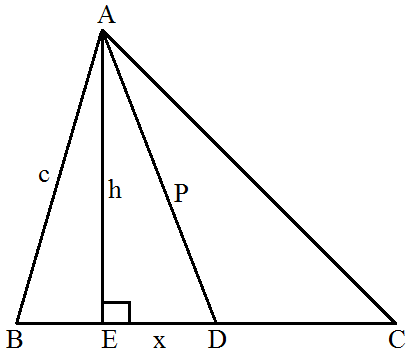
In the given figure, $D$ is the mid-point of side $BC$ and $\text{AE}\perp\text{BC}.$ If $BC = a, AC = b, AB = c, ED = x, AD = p$ and $AE = h$, prove that:
  1. $\text{b}^2=\text{p}^2+\text{ax}+\frac{\text{a}^2}{4}$
  2. $\text{c}^2=\text{p}^2-\text{ax}+\frac{\text{a}^2}{4}$
  3. $\text{b}^2+\text{c}^2=2\text{p}^2+\frac{\text{a}^2}{4}$

Image
A mixer manufacturing company manufactured 600 mixers in 3rd year and in 7th year they manufactured 700 mixers. If every year there is same growth in the production of mixers then find (i) Production in the first year (ii) Production in 10th year (iii) Total production in first seven years.
Solve the following systems of equations:
$\frac{4}{\text{x}}+3\text{y}=14,$
$\frac{1}{3\text{x}}-4\text{y}=23.$