MCQ
Which of the following sets of concurrent forces may be in equilibrium
  • A
    ${F_1} = 3N,\,\,{F_2} = 5N,\,\,{F_3} = 9N$
  • B
    ${F_1} = 3N,\,\,{F_2} = 5N,\,\,{F_3} = 1N$
  • C
    ${F_1} = 3N,\,{F_2} = 5N,\,{F_3} = 15N$
  • ${F_1} = 3N,\,\,{F_2} = 5N,\,\,{F_3} = 6N$
Answer

Correct option: D.
${F_1} = 3N,\,\,{F_2} = 5N,\,\,{F_3} = 6N$
d
(d) Range of resultant of ${F_1}$ and ${F_2}$ varies between $(3+5)=8N$ and $(5 - 3) = 2N$.

It means for some value of angle $(\theta )$, resultant $6$ can be obtained.

So, the resultant of $3\,N$, $5\,N$ and $6\,N$ may be zero and the forces may be in equilibrium.

Need a full question paper?

Generate a complete, print-ready paper with questions like this in minutes — across 16+ boards, with answer keys.

Start Generating Free

Similar questions

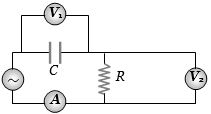
The diagram shows a capacitor $C$ and a resistor $R$ connected in series to an $ac$ source. ${V_1}$ and ${V_2}$ are voltmeters and $A$ is an ammeterConsider               now the following statements

             $I$.Readings in $A$ and $V_2$ are always in phase

             $II$.Reading in $V_1$ is ahead in phase with reading in $V_2$

             $III$.Readings in $A$ and $V_1$ are always in phase which of these statements are/is correct

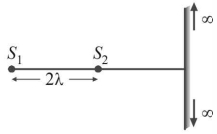
There are two sources kept at distances $2 \lambda$. A large screen is perpendicular to line joining the sources. Number of maximas on the screen in this case is $(\lambda=$ wavelength of light $)$
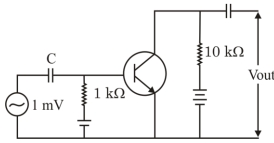
An $n.p.n$ transistor with current gain $\beta=100$ in common emitter configuration is shown in figure. The output voltage of the amplifier will be$.....V$
An object is initially at a distance of $100 \;cm$ from a plane mirror. If the mirror approaches the object at a speed of $10\; cm/sec$, then after $6\; sec$ the distance between the object and its image will be
The length of two open organ pipes are $l$ and $(l + \Delta l)$ respectively. Neglecting end correction, the frequency of beats between them will be approximately (Here $v$ is the speed of sound)
A projectile projected at an angle ${30^o}$ from the horizontal has a range $2\upsilon ,\,\sqrt 2 \upsilon \,\,{\rm{ and}}\,{\rm{zero}}$. If the angle of projection at the same initial velocity be ${60^o}$, then the range will be
When a bicycle is in motion, the force of friction exerted by the ground on the two wheels is such that it acts
Which of the following quantity/quantities are dependent on the choice of orientation of the co-ordinate axes?

$(a)$ $\vec{a}+\vec{b}$

$(b)$ $3 a_x+2 b_y$

$(c)$ $(\vec{a}+\vec{b}-\vec{c})$

A block of mass $M$ is at rest on a plane surface inclined at an angle $\theta$ to the horizontal. The magnitude of force exerted by the plane on the block is
During the adiabatic expansion of $2$ moles of a gas, the internal energy of the gas is found to decrease by $2$ joules, the work done during the process on the gas will be equal to ....... $J$