MCQ
Which of the following shows hydrogen bonding
  • $N{H_3}$
  • B
    $P$
  • C
    $As$
  • D
    $Sb$

Answer

Correct option: A.
$N{H_3}$
(a) Due to electronegativity difference of ${N_2}$ and ${H_2}$, $N{H_3}$ form hydrogen bond.

Need a full question paper?

Generate a complete, print-ready paper with questions like this in minutes — across 16+ boards, with answer keys.
Start Generating Free

Similar questions

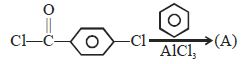
 Product $(A)$ is
For hydrogen like atoms, the average distance of electron from nucleus for the orbitals belonging to the $4^{th}$ orbit, is minimum for
When Phenol is heated with phthalic anhydride in concentrated sulphuric acid and the hot reaction mixture is poured into a dilute solution of sodium hydroxide, the product formed is
The enthalpy changes at $298\, K$ in successive breaking of $O -H$ bonds of $HOH$ are-
$H_2O (g) \to H(g) + OH (g), \Delta H = 498\, kJ \,mol^{-1}$
$OH (g) \to H(g) + O (g), \Delta H = 428\, kJ\, mol^{-1}$
The bond enthalpy of the $O-H$ bond is.....$kJ\, mol^{-1}$
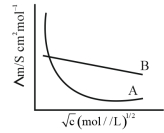
Following figure shows dependence of molar conductance of two electrolytes on concentration. $\Lambda \stackrel{0}{ m }$ is the limiting molar conductivity.The number of Incorrect statement(s) from the following is $...........$

$(A)$ $\Lambda \stackrel{0}{ m }$ for electrolyte $A$ is obtained by extrapolation

$(B)$ For electrolyte B, vx $\Lambda m$ vs $\sqrt{ c }$ graph is a straight line with intercept equal to $\Lambda \stackrel{0}{ m }$

$(C)$ At infinite dilution, the value of degree of dissociation approach zero for electrolyte $B$.

$(D)$ $\Lambda \stackrel{0}{ m }$ for any electrolyte $A$ or $B$ can be calculated using $\lambda^{\circ}$ for individual ions.
Nitrobenzene can be prepared from benzene by using a mixture of conc. $HNO_3$ and conc. $H_2SO_4.$ In the mixture, nitric acid acts as a/an
One litre of an aqueous solution contain $0.15\, mole$ of $CH_3COOH$ $(pK_a = 4.8)$ and $0.15\, mole$ of $CH_3COONa$. After the addition of $0.05\, mole$ of solid $NaOH$ to this solution, the $pH$ will be
Benzene hexachloride $ (BHC$) is used as
Reaction : $2Br^{-} + H_2O_2 + 2H^{+} \to  Br_2 + 2H_2O$

take place in two steps :

$(a)$ $Br^{-} + H^{+} + H_2O_2 \xrightarrow{{slow}} HOBr + H_2O$

$(b)$ $HOBr + Br^{-} + H^{+} \xrightarrow{{fast}} H_2O + Br_2$

The order of the reaction is 

$t _{87.5}$ is the time required for the reaction to undergo $87.5 \%$ completion and $t_{50}$ is the time required for the reaction to undergo $50 \%$ completion. The relation between $t_{87.5}$ and $t_{50}$ for a first order reaction is $t _{87.5}= x \times t _{50}$ The value of $x$ is $......$. (Nearest integer)