MCQ
Which of the following shows hydrogen bonding
  • $N{H_3}$
  • B
    $P$
  • C
    $As$
  • D
    $Sb$

Answer

Correct option: A.
$N{H_3}$
(a) Due to electronegativity difference of ${N_2}$ and ${H_2}$, $N{H_3}$ form hydrogen bond.

Need a full question paper?

Generate a complete, print-ready paper with questions like this in minutes — across 16+ boards, with answer keys.

Start Generating Free

Similar questions

Which one of the following pairs is an example of polar molecular solids?
cis and trans $ 2-$butene are
Which of the following compounds is insoluble even in hot concentrated ${H_2}S{O_4}$
Equal masses of $H_2, O_2$ and methane have been taken in a container of volume $V$ at temperature $27\, ^o C$ in identical conditions. The ratio of the volumes of gases $H_2 : O_2 :$ methane would be
The silicate anion in the mineral kinoite is a chain of three $SiO_4$ tetrahedra, that share corners with adjacent tetrahedra. The change of the silicate anion is
The compound having both $sp$ and $s{p^2}$ hybridised carbon atom is
Given below are the statements about diborane.

$(a)$ Diborane is prepared by the oxidation of $\mathrm{NaBH}_{4}$ with $\mathrm{I}_{2}$.

$(b)$ Each boron atom is in sp $^{2}$ hybridized state.

$(c)$ Diborane has one bridged $3$ centre$-2-$electron bond.

$(d)$ Diborane is a planar molecule.

The option with correct statement(s) is :

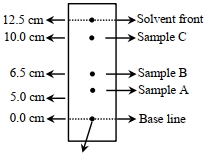
Using the given figure, the ratio of $R_t$ values of sample $A$ and sample $\mathrm{C}$ is $\mathrm{x} \times 10^{-2}$. Value of $\mathrm{x}$ is . . . . . . . . 

(Image)

Samples $(A, B, C)$

Fig : Paper chromatography of Samples
For the reversible reaction in equilibrium

${N_2}\left( g \right) + {O_2}\left( g \right)\underset{{{k_2}}}{\overset{{{k_1}}}{\longleftrightarrow}}2NO\left( g \right)$

$C_0 = Ce^{-2.1×10^{-3}\ t}$ for the forward reaction and

$C_0'= C'e^{-4.2×10^{-4}\ t}$ for the backward reaction, hence $K_c$ for the above equilibrium is

Elements $A$ and $B$ with their respective electronic configurations $3{d^{10}}\,4{s^1}$ and $4{d^{10}}\,5{s^1}$ in their outermost shell are