MCQ
Which of the following solid has maximum melting point ?
  • A
    $NaCl$
  • B
    $Ice$
  • C
    $Dry\, ice$
  • $SiO_2$

Answer

Correct option: D.
$SiO_2$
d

Need a full question paper?

Generate a complete, print-ready paper with questions like this in minutes — across 16+ boards, with answer keys.

Start Generating Free

Similar questions

When phenol reacts with ammonia in presence of $CuC{l_2}$ at  $300\,^o C,$  it gives
Addition of $Br_2$ to cis- $2$ -butene would give a product which is
$\begin{array}{*{20}{c}}
{Ph - C{H_2} - CH - C{H_2} - C{H_3}}\\
{|\,\,\,\,\,\,\,}\\
{Br\,\,\,\,\,}
\end{array}$ $\xrightarrow{{NaN{H_2}}}\left( A \right)$ 

Total no. of elimination products are (includes stereoisomers)

$1.80\,g$ of solute $A$ was dissolved in $62.5\,cm ^{3}$ of ethanol and freezing point of the solution was found to be $155.1\,K$. The molar mass of solute $A$ is $..........g\,\,mol ^{-1}$.

[Given: Freezing point of ethanol is $156.0 K$ Density of ethanol is $0.80\,g\,cm ^{-3}$.

Freezing point depression constant of ethanol is $\left.2.00\,K\,kg\,mol\,m ^{-1}\right]$
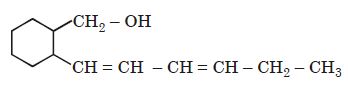
Total number of stereo-isomers possible for the following compound is
Covalent molecules are usually held in a crystal structure by
Copper from copper sulphate solution can be displaced by .............. The standard reduction potentials of some electrodes are given below

$E^o (Fe^{+2}, Fe) = -0.44$ $ V$

$E^o (Zn^{+2}, Zn) = -0.76$ $ V$

$E^o (Cu^{+2}, Cu) = +0.34$ $V$

$E^o (Cr^{+2}, Cr) = -0.74$  $V$

$E^o (H^+, 1/2H_2) = -0.00$ $V$

Which is the example of branch isomerization
$Pb\,+\,Dil.\,HN{{O}_{3}}\,\xrightarrow{Warm}\,P+Q\uparrow \,+\,{{H}_{2}}O$

Incorrect statement for $Q$ is

.........  $gm$ weight of non-volatile solute having molecular weight $40$, which should be dissolve in $57\, g$ octane to reduce its vapour pressure to $80\%$.