MCQ
Which of the following solid salt on heating with solid $K_2Cr_2O_7$ and conc. $H_2SO_4$ orange red vapours are evolved which tum aquous $NaOH$ solution yellow ?
  • A
    $NaBr$
  • $NaCl$
  • C
    $NaNO_3$
  • D
    $NaI$

Answer

Correct option: B.
$NaCl$
b
$NaC{l_{\left( s \right)}} + {K_2}C{r_2}{O_7}_{\left( s \right)} + {H_2}S{O_4}$ $\left( {{\text{few drop}}} \right)\xrightarrow[{reaction}]{{Non - redox}}$ $\mathop {Cr{O_2}C{l_2}}\limits_{\left( {orange{\kern 1pt} red{\kern 1pt} vapours} \right)} {\mkern 1mu}  \uparrow  + HO$

$Cr{O_2}C{l_2} + OH_{\left( {aq} \right)}^ - $ $\to $  $\mathop {CrO_{4\left( {aq.} \right)}^{2 - }}\limits_{Yellow{\kern 1pt} solution} {\mkern 1mu}  + C{l^ - } + 2{H_2}O$

Need a full question paper?

Generate a complete, print-ready paper with questions like this in minutes — across 16+ boards, with answer keys.

Start Generating Free

Similar questions

$1.8\, g$ of fructose is added to $2\, kg$ of water. The freezing point of the solution is $(k_f = 1.86\, K\, m^{-1})$
Which metal oxide is used to obtain blue coloured glass?
Inversion of configuration observed :
The vapour pressure of water at room temperature is $23.8\, mm\, Hg$. The vapour pressure of an aqueous solution of sucrose with mole fraction of $0.1$ is equal to .......... $mm\, Hg$.
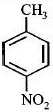
In a set of reactions $p-$ nitrotoluene yielded a product $E$. The product $E$ would be

(Figure) $\xrightarrow[FeB{{r}_{3}}]{B{{r}_{2}}}B\xrightarrow{Sn\,/\,HCl}C$ $\xrightarrow[HCl]{NaN{{O}_{2}}}D\xrightarrow[HBr]{CuBr}E$
For each of the following pairs of $E_2$ reaction, select the one that occurs with  the greater rate constant.

$(1)$ $C{H_3}C{H_2}C{H_2}Cl + $ $\begin{array}{*{20}{c}}
  {\,\begin{array}{*{20}{c}}
  {\,\,\,\,\,\,\,\,\,\,C{H_3}} \\ 
  {\,\,\,|} 
\end{array}} \\ 
  {C{H_3} - C - {O^ - }} \\ 
  {\,\,\,|} \\ 
  {\,\,\,\,\,\,\,\,\,\,C{H_3}} 
\end{array}$                      $(2)$  $C{H_3}C{H_2}C{H_2}I + $$\begin{array}{*{20}{c}}
  {\,\begin{array}{*{20}{c}}
  {\,\,\,\,\,\,\,\,\,\,C{H_3}} \\ 
  {\,\,\,|} 
\end{array}} \\ 
  {C{H_3} - C - {O^ - }} \\ 
  {\,\,\,|} \\ 
  {\,\,\,\,\,\,\,\,\,\,C{H_3}} 
\end{array}$

$(3)$  $\begin{array}{*{20}{c}}
  {{H_3}C - CH - C{H_3}} \\ 
  {|\,\,\,\,} \\ 
  {Br\,\,\,} 
\end{array}$  $+CH_3O^-$                      $(4)$  $\begin{array}{*{20}{c}}
  {{H_3}C - CH - C{H_3}} \\ 
  {|\,\,\,\,} \\ 
  {Br\,\,\,} 
\end{array}$ $+CH_3S^-$

At certain temperature $(T)$ if conductivity of pure water is $5.5 × 10^{-7}\ Scm^{-1}$, then calculate $pH$ of water at given temp. Given :$\lambda _{{H^ + }}^\infty = 350\ S\,cm^2 \,eq^{-1}$

$\lambda _{O{H^ - }}^\infty$ $=200\, \ S\,cm^2 \,eq^{-1}$
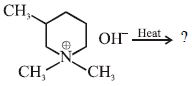
What is the major alkene formed in the following hofmann elimination
Reduction of acetyl chloride with ${H_2}$ in presence of  $Pd$  gives
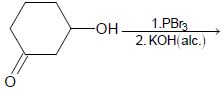
The major product of the following reaction is