MCQ
Which of the following solutions will have the highest boiling point
  • A
    $1\%$  glucose
  • B
    $1\%$  sucrose
  • C
    $1\% $ $NaCl$
  • $1\%$  $CaC{l_2}$

Answer

Correct option: D.
$1\%$  $CaC{l_2}$
d
(d)$CaC{l_2}$ gives maximum ion hence it shows highest boiling point.

Need a full question paper?

Generate a complete, print-ready paper with questions like this in minutes — across 16+ boards, with answer keys.

Start Generating Free

Similar questions

$C{H_3} - C{H_2} - CH = O\,\xrightarrow[{(2)\,\,{H^ \oplus }}]{{(1)\,\,{\text{Tollen's reagent}}}}X$ $\,\xrightarrow[{(2)\,\,{\text{drydistillation}}}]{{(1)\,Ca{{(OH)}_2}}}\,Y$ ; $Y$ is
$C{H_3}C \equiv CC{H_3}\mathop {\xrightarrow{{(i){\text{ }}X}}}\limits_{(ii){H_2}O/Zn}$

$\begin{array}{*{20}{c}}
  {C{H_3} - C - C - C{H_3}} \\ 
  {|\,\,\,\,\,\,\,\,\,\,\,\,|} \\ 
  {O\,\,\,\,\,\,\,\,\,O} 
\end{array}$  $X$ in the above reaction is

Common oxidation state of scandium, a transition element is/are [atomic number of $Sc = 21$
The orientation of an atomic orbital is governed by
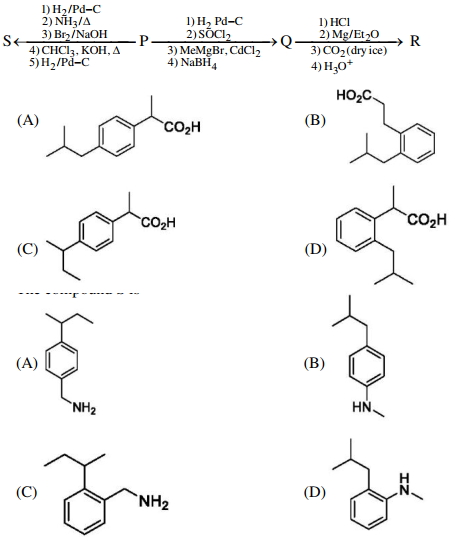
An organic acid $P \left( C _{11} H _{12} O _2\right)$ can easily be oxidized to a dibasic acid which reacts with ethyleneglycol to produce a polymer dacron. Upon ozonolysis, $P$ gives an aliphatic ketone as one of the products. $P$ undergoes the following reaction sequences to furnish $R$ via $Q$. The compound $P$ also undergoes another set of reactions to produce $S$.

(image)   

($1$) The compound $R$ is

(image) 

($2$) The compound $S$ is

(image) 

Give the answer or quetion ($1$) and ($2$)
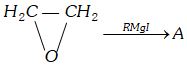
The product $‘A’$ in the following reaction is
Which is the correct sequence in the following, poperties? For the correct order mark $(T)$ and for the incorrect order mark $(F)$

$(a)$ Lewis acidity order : $SiF_4 < SiC_{4} < SiBr_4 < Sil_4$

$(b)$ Melting point : $NH_3 > SbH_3 > AsH_3 > PH_3$

$(c)$ Boiling point : $NH_3 > SbH_3 > AsH_3 > PH_3$

$(d)$ Dipole moment order : $NH_3 > SbH_3 > AsH_3 > PH_3$

Polyvinylalcohol can be prepared by
In which of the following pair both the species have $s p^{3}$ hybridization ?
Product of the reaction 

$\begin{array}{*{20}{c}}
  {\begin{array}{*{20}{c}}
  {\,\,\,\,C{H_2} - O - C{H_3}} \\ 
  {|\,\,\,\,\,\,\,\,\,\,\,\,\,\,\,\,\,\,\,\,\,\,\,\,\,\,\,\,\,\,\,\,\,\,\,\,\,} 
\end{array}} \\ 
  {\,\,CH - O - C{H_3}} \\ 
  {|\,\,\,\,\,\,\,\,\,\,\,\,\,\,\,\,\,\,\,\,\,\,\,\,\,\,\,\,\,\,\,\,\,\,\,\,} \\ 
  {\,\,C{H_2} - O - C{H_3}} 
\end{array}\xrightarrow{{HI(excess)}}$