MCQ
Which of the following species is paramagnetic in nature
- ACarbanion
- BCarbonium ion
- ✓Free radical
- DAll the above
$C{H_3} - CH = C{H_2} + HBr \to C{H_3} - \mathop {\mathop C\limits^| H}\limits^{Br\,} - C{H_3}$
(According to markownikoff rule)
But the halogen bonded with terminal carbon so it take place in presence of peroxide by free radical mechanism.
$\mathop {R - O - OR}\limits_{{\rm{peroxide}}} \to 2R\mathop O\limits^. $; $HBr + \mathop {RO}\limits^. \to ROH + B{r^.}$
$C{H_3} - CH = C{H_2} + B{r^.} \to C{H_3} - C\mathop H\limits^. - C{H_2} - Br$
$C{H_3} - \mathop C\limits^. H - C{H_2}Br + HBr \to $ $C{H_3} - C{H_2} - C{H_2}Br + B{r^.}$
Generate a complete, print-ready paper with questions like this in minutes — across 16+ boards, with answer keys.
Where $kd =$ Dissociation constant
In the above reaction, if the reactant alcohol is a pure $R-$ isomer the product would.
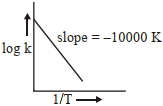
The temperature at which the rate constant of the reaction is $10^{-4} s ^{-1}$ is .............. $K$.
(Rounded-off to the nearest integer)
[Given: The rate constant of the reaction is $10^{-5} s ^{-1}$ at $500 K$.]