MCQ
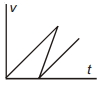
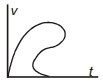
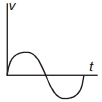
Which of the following speed-time $(v-t)$ graphs is physically not possible?
  • A

  • B

  • C

  • All of these

Answer

Correct option: D.
All of these
d
(d)

None of the graph is physically possible.

Need a full question paper?

Generate a complete, print-ready paper with questions like this in minutes — across 16+ boards, with answer keys.
Start Generating Free

Similar questions

The potential energy of a particle of mass $5kg$ moving in the $XY$ plane is given by $V= -7x+24y$ joules, $x$ and $y$ being in metres. Initially at $t=0$ the particle is at the origin $(0,0)$ moving with $a$ velocity of $6[ \hat i (2.4)+ \hat j (0.7)] m/s$. Then
A $1 cm$ long string vibrates with fundamental frequency of $256\, Hz$. If the length is reduced to $\frac{1}{4}cm$ keeping the tension unaltered, the new fundamental frequency will be
A ray of light is incident at an angle of $60^o$ on one face of a prism of angle $30^o$ . The emergent ray of light makes an angle of $30^o$  with incident ray. The angle made by the emergent ray with second face of prism will be....$^o$
pendulum made of a uniform wire of cross sectional area $A$ has time period $T$. When an additional mass $M$ is added to its bob, the time period changes to $T_M$. If the Young's modulus of the material of the wire is $Y$ then $\frac{1}{Y}$ is equal to : ($g$ = gravitational acceleration)
A galvanometer having a resistance of $20\,\Omega $ and $30\, divisions$ on both sides has figure of merit $0.005\, ampere /division$. The resistance that should be connected in series such that it can be used as a voltmeter upto $15\, volt$ is ........... $\Omega$
Which one of the following is a simple harmonic motion
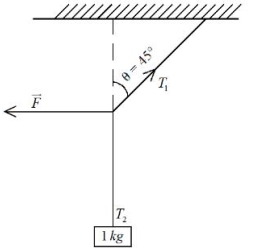
A $1 \mathrm{~kg}$ mass is suspended from the ceiling by a rope of length $4 \mathrm{~m}$. A horizontal force ' $F$ ' is applied at the mid point of the rope so that the rope makes an angle of $45^{\circ}$ with respect to the vertical axis as shown in figure. The magnitude of $F$ is:
A current i passes through a wire of length $l$, radius of cross-section $r$ and resistivity $\rho$. The rate of heat generation is
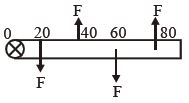
Four equal and parallel forces are acting on a rod (as shown in fig.) at distances of $20 \,cm,  40\, cm, 60\, cm$ and $80\, cm$ respectively from one end of the rod under the influence of  these forces the rod -
A body of capacity $4\,\mu \,F$ is charged to $80\,V$ and another body of capacity $6\,\mu \,F$ is charged to $30\,V$. When they are connected the energy lost by $4\,\mu \,F$ capacitor is.......$mJ$