MCQ
Which of the following statement is correct about ionization potential?
  • A
    It is independent of atomic radii
  • B
    It remains constant with change in atomic radii
  • C
    It increases with an increase in atomic radii
  • It decreases with an increase in atomic radii
Answer

Correct option: D.
It decreases with an increase in atomic radii

d
The ionisation potential decreases with increase in atomic radii.

Need a full question paper?

Generate a complete, print-ready paper with questions like this in minutes — across 16+ boards, with answer keys.

Start Generating Free

Similar questions

$x{A_{\left( s \right)}}\, \rightleftharpoons \,y{B_{(g)}} + z{C_{(g)}}$ If $\frac{{{k_c}}}{{{k_p}}}\, = {(RT)^{ - 2}},$  then which is correct
Match List $I$ w1th List $II$

LIST $I$

(Precipitating reagent and

conditions)

LIST $II$

(Cation)

$A$ $\mathrm{NH}_4 \mathrm{Cl}+\mathrm{NH}_4 \mathrm{OH}$ $I$ $\mathrm{Mn}^{2+}$
$B$ $\mathrm{NH}_4 \mathrm{OH}+\mathrm{Na}_2 \mathrm{CO}_3$ $II$ $\mathrm{Pb}^{2+}$
$C$ $\mathrm{NH}_4 \mathrm{OH}+\mathrm{NH}_4 \mathrm{Cl}+\mathrm{H}_2 \mathrm{~S}$ gas $III$ $\mathrm{Al}^{3+}$
$D$ dilute $\mathrm{HCl}$ $IV$ $\mathrm{Sr}^{2+}$

Choose the correct answer from the options given below:

An aromatic compound of molecular formula $C_6H_4Br_2$ was nitrated when three isomers of formula $C_6H_3Br_2NO_2$ were obtained. The original compound is :
Contrary to other hydrogen halides, hydrogen fluoride is a liquid because
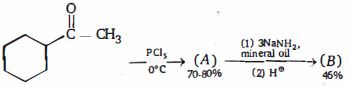
Product $(B)$ is
Which has weakest bond
The decreasing order of electrical conductivity of the following aqueous solutions is
$0.1\, M$ Formic acid $(a)$
$0.1\, M$ Acetic acid $(b)$
$0.1\, M$ Benzoic acid $(c)$
On the basis of thermochemical equations (a), (b) and (c), find out which of the algebric relationships given in options (i) to (iv) is correct.

  1. $\text{C}(\text{graphite})+\text{O}_2(\text{g})\rightarrow\text{CO}_2(\text{g});\Delta_\text{r}\text{H}=\text{x}\text{kJ}\ \text{mol}^{-1}$

  2. $\text{C}(\text{graphite})+\frac{1}{2}\text{O}_2(\text{g})\rightarrow\text{CO}(\text{g});\Delta_\text{r}\text{H}=\text{y} \text{kJ}\ \text{mol}^{-1}$

  3. $\text{CO}(\text{g})+\frac{1}{2}\text{O}_2(\text{g})\rightarrow\text{CO}_2(\text{g});\Delta_\text{r}\text{H}=\text{z}\text{kJ}\ \text{mol}^{-1}$

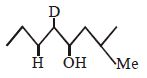
How many chiral carbon atoms are present in following compound :-
For the given compound $X$, the total number of optically active stereoisomers is. . . . . . .