MCQ
Which of the following statement is correct?
  • A
    Every L.P.P. has atleast one optimal solution.
  • B
    Every L.P.P. has a unique optimal solution.
  • If an L.P.P. has two optimal solutions, then it has infinitely many solutions.
  • D
    None of these

Answer

Correct option: C.
If an L.P.P. has two optimal solutions, then it has infinitely many solutions.
(c) : If optimal solution is obtained at two distinct points $A$ and $B$ (corners of the feasible region), then optimal solution is obtained at every point of segment $[A B]$.

Need a full question paper?

Generate a complete, print-ready paper with questions like this in minutes — across 16+ boards, with answer keys.

Start Generating Free

Similar questions

Let $f:(0,2) \rightarrow R$ be defined as $f( x )=\log _{2}\left(1+\tan \left(\frac{\pi x }{4}\right)\right)$ Then, $\lim _{n \rightarrow \infty} \frac{2}{n}\left(f\left(\frac{1}{n}\right)+f\left(\frac{2}{n}\right)+\ldots+f(1)\right)$ is equal to
A vector of length $3$  perpendicular to each of the vectors $3\,i + j - 4\,k$ and $6\,i + 5\,j - 2\,k$ is
Find the principal value of: $\tan ^{-1}(-1)$.
Let $ABC$ be a triangle such that $\overrightarrow{ BC }=\overrightarrow{ a }, \overrightarrow{ CA }=\overrightarrow{ b }$, $\overrightarrow{ AB }=\overrightarrow{ c },|\overrightarrow{ a }|=6 \sqrt{2}, \quad|\overrightarrow{ b }|=2 \sqrt{3}$ and $\overrightarrow{ b } \cdot \overrightarrow{ c }=12$ Consider the statements.

$( S 1):|(\overrightarrow{ a } \times \overrightarrow{ b })+(\overrightarrow{ c } \times \overrightarrow{ b })|-|\overrightarrow{ c }|=6(2 \sqrt{2}-1)$

$( S 2): \angle ABC =\cos ^{-1}\left(\sqrt{\frac{2}{3}}\right)$. Then

Statement $-1 :$  The point $A(1, 0, 7)$ is the mirror image of the point $B( 1, 6, 3)$ in the line:  $\frac{x}{1} = \frac{{y - 1}}{2} = \frac{{z - 2}}{3}$

Statement $-2 :$ The line $\frac{x}{1} = \frac{{y - 1}}{2} = \frac{{z - 2}}{3}$ bisects the line joining $A(1, 0, 7)$ and $B( 1, 6, 3)$
$\int|\text{x}|\text{dx}$ is equal to :
If ${\sin ^{ - 1}}\frac{x}{5} + {\rm{cose}}{{\rm{c}}^{ - 1}}\left( {\frac{5}{4}} \right) = \frac{\pi }{2},$ then $x = $
The value of $\int\limits_0^4 {\left\{ {\sqrt x } \right\}dx,} $ where $\{ \}$ denotes the fractional part of $x$ is
$\int_{}^{} {\frac{{dx}}{{\sqrt {{x^2} - {a^2}} }}} $ equals
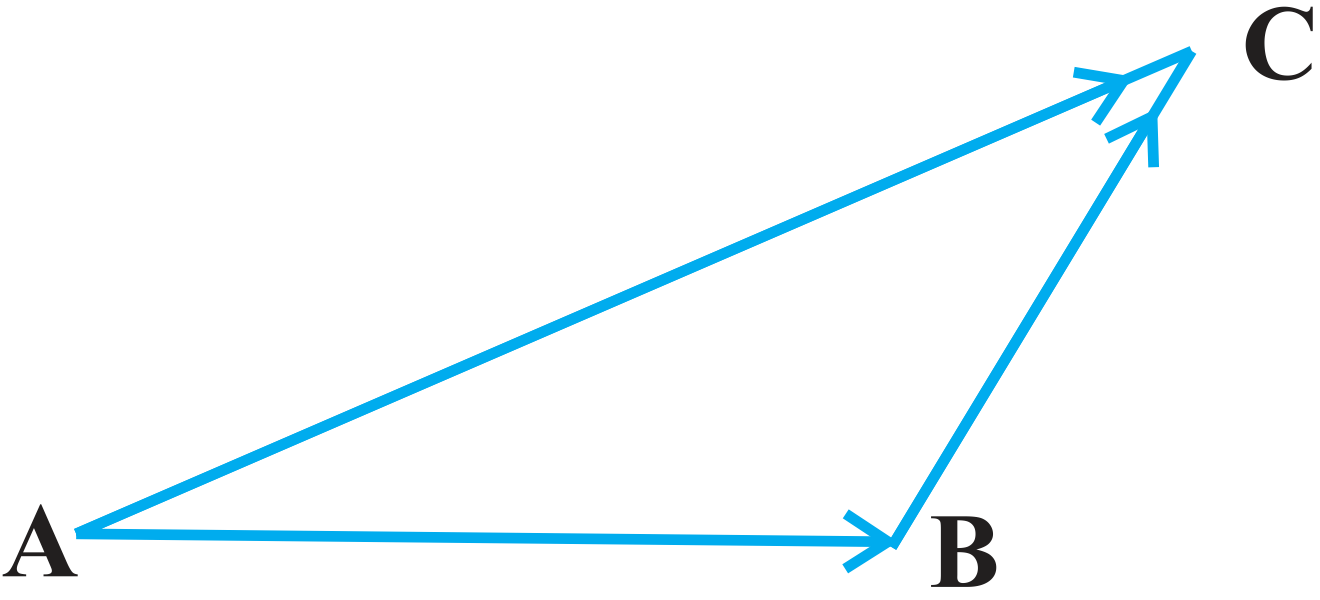
In triangle ABC (Fig 10.18), which of the following is not true: