- APhenol is neutralised by sodium carbonate.
- BPhenol is used to prepare analgesic drugs.
- CSolubility of phenol in water is more than that of chlorobenzene.
- DBoiling point of o-nitrophenol is lower than that of p-nitrophenol.
Explanation:
Phenol does not react with Na2CO3 because it is weaker acid than carboxylic acid and thereby do not have the strength to substitute or give away its H+ ions to that of weak bases like sodium carbonate.
Phenol is used for the preparation of aspirin which is used as an analgesic as well as antipyretic drugs.
Phenol is more soluble in water than chlorobenzene due to formation of H-bond with water molecules.
o-nitrophenol form intramolecular H−bonding while p-nitrophenol form intermolecular H−bonding. Due to this, nature o-nitrophenol has a lower boiling point than p-nitrophenol.
Generate a complete, print-ready paper with questions like this in minutes — across 16+ boards, with answer keys.
(image)
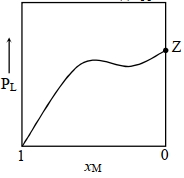
$[A]$ Attractive intermolecular interactions between $L-L$ in pure liquid $L$ and $M-M$ in pure liquid $M$ are stronger than those between $L-M$ when mixed in solution
$[B]$ The point $Z$ represents vapour pressure of pure liquid $M$ and Raoult's law is obeyed when $x_{L} \rightarrow 0$
$[C]$ The point $Z$ represents vapour pressure of pure liquid $L$ and Raoult's law is obeyed when $x_{\mathrm{L}} \rightarrow 1$
$[D]$ The point $Z$ represents vapour pressure of pure liquid $M$ and Raoult's law is obeyed from $x_{L}=0$ to $x_{L}=1$
$(i)$ Ionization $(ii)$ Hydrate $(iii)$ Coordination $(iv)$ Geometrical $(v)$ Optical
Which of the above isomerisms are exhibited by $[Cr(NH_3)_2 (OH)_2 Cl_2]^-$?