MCQ
Which of the following statement is not true about amorphous solids?
  • A
    On heating they may become crystalline at certain temperature.
  • B
    They may become crystalline on keeping for long time.
  • C
    Amorphous solids can be moulded by heating.
  • They are anisotropic in nature.

Answer

Correct option: D.
They are anisotropic in nature.
Amorphous solids are isotropic because they show thermal and optical properties, same in all directions.

Need a full question paper?

Generate a complete, print-ready paper with questions like this in minutes — across 16+ boards, with answer keys.

Start Generating Free

Similar questions

Given below are two statements: one is labelled as Assertion $(A)$ and the other is labelled as Reason $(R)$ :

Assertion $(A)$ : $\mathrm{S}_{\mathrm{N}} 2$ reaction of $\mathrm{C}_6 \mathrm{H}_5 \mathrm{CH}_2 \mathrm{Br}$ occurs more readily than the $\mathrm{S}_{\mathrm{N}} 2$ reaction of $\mathrm{CH}_3 \mathrm{CH}_2 \mathrm{Br}$.

Reason $(R)$ : The partially bonded unhybridized p-orbital that develops in the trigonal bipyramidal transition state is stabilized by conjugation with the phenyl ring.

In the light of the above statements, choose the most appropriate answer from the options given below:

The osmotic pressure of solution increases, if
When carboxylic acid reacts with organolithium reagents to give ketones side  reaction sometimes occur. For example,

$\begin{matrix}
   \,\,\,\,\,\,\,\,\,\,\,\,\,\,\,\,\,\,\,\,\,\,\,\,\,\,\,C{{H}_{3}}\,\,\,\,\,\,\,\,\,\,\,\,\,\,\,\,\,\,\,\,\,\,\,O  \\
   \,\,\,\,\,\,\,\,\,\,\,\,\,\,\,\,\,\,\,\,\,\,\,\,\,|\,\,\,\,\,\,\,\,\,\,\,\,\,\,\,\,\,\,\,\,\,\,\,\,\,\,\,\,\,\,\,\,\,||  \\
   HOC{{H}_{2}}C{{H}_{2}}CHC{{H}_{2}}C{{H}_{2}}COH  \\
\end{matrix}$ $\xrightarrow[tetrahydro\,\,futan ]{(x)\,\,C{{H}_{3}}Li}$ $\xrightarrow[{{H}_{2}}]{N{{H}_{4}}Cl}$ $\underset{Compound\,\,\,A\,\,63\,\%}{\mathop{\begin{matrix}
   \,\,\,\,\,\,\,\,\,\,\,\,C{{H}_{3}}\,\,\,\,\,\,\,\,\,\,\,\,\,\,\,\,\,\,\,\,\,\,\,\,\,\,\,\,\,\,O\,  \\
   \,\,\,\,\,\,\,\,\,\,\,\,|\,\,\,\,\,\,\,\,\,\,\,\,\,\,\,\,\,\,\,\,\,\,\,\,\,\,\,\,\,\,\,\,\,\,\,\,\,\,||  \\
   HOC{{H}_{2}}C{{H}_{2}}CHC{{H}_{2}}C{{H}_{2}}-C-C{{H}_{3}}  \\
\end{matrix}}}\,$ $\underset{37\,\%}{\mathop{+\,\,Compound\,\,(B)}}\,$

Value of $(x)$ in above reaction is
Hydrolysis of alkyl isocyanide yields:
$\mathrm{N}_{2} \mathrm{O}_{5(9)} \rightarrow 2 \mathrm{NO}_{2(9)}+\frac{1}{2} \mathrm{O}_{2(\mathrm{~g})}$

In the above first order reaction the initial concentration of $\mathrm{N}_{2} \mathrm{O}_{5}$ is $2.40 \times 10^{-2}\, \mathrm{~mol} \,\mathrm{~L}^{-1}$ at $318 \,K.$ The concentration of $\mathrm{N}_{2} \mathrm{O}_{5}$ after $1\, hour$ was $1.60 \times 10^{-2}\, \mathrm{~mol} \,\mathrm{~L}^{-1}$, The rate constant of the reaction at $318\, \mathrm{~K}$ is $.....\,\times 10^{-3} \mathrm{~min}^{-1}$. (Nearest integer)

[Given: $\log 3=0.477, \log 5=0.699$ ]

The molal elevation constant depends upon:
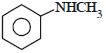
Predict the product.

(image) $+ NaNO_2+HCl \rightarrow $ product

Copper turnings when heated with concentrated sulphuric acid will give
Which enzyme converts glucose and fructose both into ethanol
The reaction of ethylene glycol with $P{I_3}$ gives