MCQ
Which of the following statement is not true regarding Einsteins mass energy relation?
  • A
    Mass disappears to reappear as energy.
  • B
    Energy disappears to reappear as mass.
  • C
    Mass and energy are two different forms of the same entity.
  • D
    Mass and energy can never be related to each other.
Answer

  1. Mass and energy can never be related to each other.

Need a full question paper?

Generate a complete, print-ready paper with questions like this in minutes — across 16+ boards, with answer keys.

Start Generating Free

Similar questions

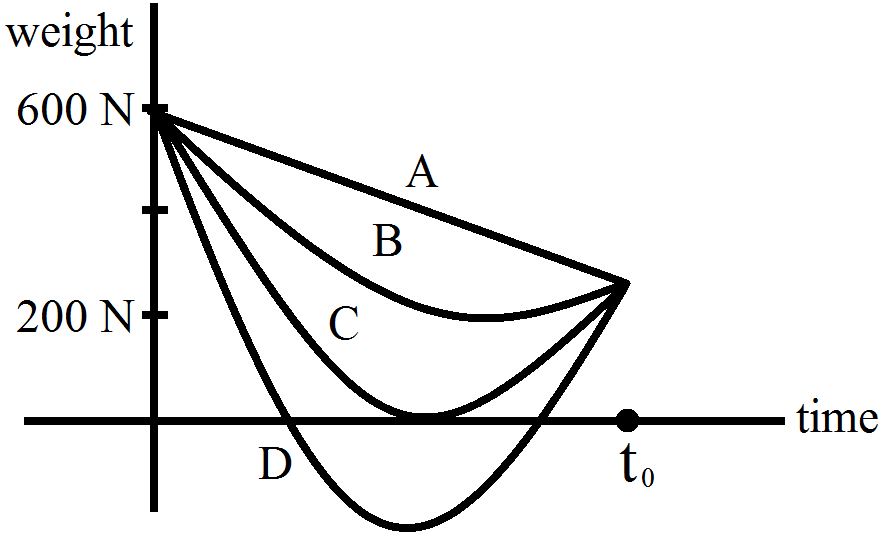
Suppose, the acceleration due to gravity at the earth's surface is 10ms-2 and at the surface of Mars it is 4⋅0ms-2. A 60kg passenger goes from the earth to the Mars in a spaceship moving with a constant velocity. Neglect all other objects in the sky. Which part of best represents the weight (net gravitational force) of the passenger as a function of time?

  1. A
  2. B
  3. C
  4. D
Cutoff wavelength of X-rays coming from a Coolidge tube depends on the:
A capacitor is charged by a battery and then the battery is disconnected. A dielectric slab is introduced between the plates. The result is:

The  emf of a battery  is 2 V  and  its  internal  resistance is 0.5 W. The maximum power which it can deliver to any external circuit will be

(a) 8 Watt

(b) 4 Watt

(c) 2 Watt

(d) None of the above

The points resembling equal potentials are

(a) P and Q

(b) S and Q

(c) S and R

(d) P and R

A sinusoidal voltage of peak value 200 volt is connected to a diode and resistor R in the circuit shown so that half wave rectification occurs. If the forward resistance of the diode is negligible compared to R the rms voltage (in volt) across R is approximately

(a) 200

(b) 100

(c)  

(d) 280

A wire is placed parallel to the lines of force in a magnetic field and a current flows in the wire. Then:

The period of oscillation of a vibration magnetometer depends on which of the following factors

(a) I and M only

(b) M and H only

(c) I and H only

(d) I, M and H only

Rest mass energy of an electron is 0.51 MeV. If this electron is moving with a velocity 0.8 c (where c is velocity of light in vacuum), then kinetic energy of the electron should be.

(a) 0.28 MeV

(b) 0.34 MeV

(c) 0.39 MeV

(d) 0.46 MeV

Which of the following helps us in the determination of the temperature of sun

(a) Kirchhoff's law

(b) Maxwell Boltzmann law

(c) Planck's law

(d) Stefan's law