MCQ
Which of the following statement is true?
  • A
    Kinetic energy is conserved in all types of collisions.
  • By definition there is no difference between elastic and perfectly elastic collisions.
  • C
    By definition there is no difference between inelastic and perfectly inelastic collisions.
  • D
    After the collision, the relative displacement of the particles decreases with time.

Answer

Correct option: B.
By definition there is no difference between elastic and perfectly elastic collisions.
b
If we consider the elastic collision of two bodies

having masses $\mathrm{m}_{1}$ and $\mathrm{m}_{2},$ then according to law of conservation of momentum,

$\mathrm{m}_{1} \mathrm{u}_{1}+\mathrm{m}_{2} \mathrm{u}_{2}=\mathrm{m}_{1} \mathrm{v}_{1}+\mathrm{m}_{2} \mathrm{v}_{2}$

or $\mathrm{m}_{1}\left(\mathrm{u}_{1}-\mathrm{v}_{2}\right)=\mathrm{m}_{2}\left(\mathrm{v}_{2}-\mathrm{u}_{2}\right)$     $...(i)$

According to law of conservation of $\mathrm{KE}$

$\frac{1}{2} m_{1} u_{1}^{2}+\frac{1}{2} m_{2} u_{2}^{2}=\frac{1}{2} m_{1} v_{1}^{2}+\frac{1}{2} m_{2} v_{2}^{2}$

Or $m_{1}\left(u_{1}^{2}-v_{1}^{2}\right)=m_{2}\left(v_{2}^{2}-u_{2}^{2}\right)$         $...(ii)$

Dividing eqn. $(ii)$ by eqn. $(i),$ we have,

$\mathrm{u}_{1}+\mathrm{v}_{1}=\mathrm{v}_{2}+\mathrm{u}_{2} \quad \text { or } \quad\left(\mathrm{u}_{1}-\mathrm{u}_{2}\right)=\left(\mathrm{v}_{2}-\mathrm{v}_{1}\right)$

or $\frac{\mathrm{v}_{2}-\mathrm{v}_{1}}{\mathrm{u}_{1}-\mathrm{u}_{2}}=1$

i.e, $\mathrm{e}=1$ (condition for collision to be perfectly elastic), i.e., there is no differnce between elastic and perfectly elastic collision by definition.
Need a full question paper?

Generate a complete, print-ready paper with questions like this in minutes — across 16+ boards, with answer keys.

Start Generating Free

Similar questions

During the first $18\,min$ of a $60\,min$ trip, a car has an average speed of $11\,m / s$. What should be the average speed for remaining $42\,min$ so that car is having an average speed of $21\,m / s$ for the entire trip?
An ideal gas filled in a cylinder occupies volume $V$. The gas is compressed isothermally to the volume $V/3$. Now, the cylinder valve is opened and the gas is allowed to leak keeping temperature same. What percentage of the number of molecules should escape to bring the pressure in the cylinder back to its original value?
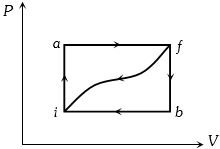
When a system is taken from state $i$ to a state $f$ along path $iaf, \,Q = 50\,J$ and $W = 20J.$ Along path $ibf, \,Q = 35J.$ If $W = - 13J$ for the curved return path $f i, Q$ for this path is ...... $J$
A uniform thin bar of mass $6 \,kg$ and length $2.4\, meter$ is bent to make an equilateral hexagon. The moment of inertia about an axis passing through the centre of mass and perpendicular to the plane of hexagon is ...... $\times \,10^{-1} \,kg m ^{2}$
For a body moving with constant speed in a horizontal circle, which of the following remains constant?
Which of the following circular rods. (given radius $ r$ and length $l$ ) each made of the same material as whose ends are maintained at the same temperature will conduct most heat
The frequency of a sound wave is n and its velocity is v. If the frequency is increased to 4n, the velocity of the wave will be:
A hammer of mass $1kg$ having speed of $50 \,m/s$, hit a iron nail of mass $200\, gm.$ If specific heat of iron is $0.105\, cal/gm°C$ and half the energy is converted into heat, the raise in temperature of nail is........ $^oC$
A projectile is thrown at an angle $\theta$ with the horizontal and its range is $R_1$. It is then thrown at an angle $\theta$ with vertical and the range is $R_2$, then
A heavy iron bar, of weight $\mathrm{W}$ is having its one end on the ground and the other on the shoulder of a person. The bar makes an angle $\theta$ with the horizontal. The weight experienced by the person is: