MCQ
Which of the following statement is wrong ?
  • The stability of hydride increases from $NH_3$ to $BiH_3$ in group $15$ of the periodic table.
  • B
    Nitrogen cannot form $d\pi - p\pi$ bond.
  • C
    Single $N- N$ bond is weaker than the single $P- P$ bond.
  • D
    $N_2O_4$ has two resonance structures.

Answer

Correct option: A.
The stability of hydride increases from $NH_3$ to $BiH_3$ in group $15$ of the periodic table.
a
The case of formation and stality of hydrides decreases ravidly from to $B H_{3}$. This is evident from their theirsociation temperature which decosses for $N H_{3}$ to $B H_{3} .$ As we group the size of central from thoreases and thus metal- hydrogen bond becomes weaker due to decreased overlap between the large central atom and small hydrogen atom.

Most stable to least stable order

$N H_{3}>P H_{3}>A s H_{3}>S b H_{3}>B i H_{3}$

Need a full question paper?

Generate a complete, print-ready paper with questions like this in minutes — across 16+ boards, with answer keys.

Start Generating Free

Similar questions

In which of the following reactions, standard reaction entropy change $(\Delta S^o)$ is positive and standard Gibb's energy change $(\Delta G^o)$ decreases sharply with increasing temperature ?
Which is a Lewis base
The catalytic activity of the transition metals and their compounds is ascribed to their
The $IUPAC$ name of the complex

$\left[\mathrm{Pt}\left(\mathrm{NH}_{3}\right)_{2} \mathrm{Cl}\left(\mathrm{NH}_{2} \mathrm{CH}_{3}\right)\right] \mathrm{Cl}$ is 

The correct order of increasing intermolecular hydrogen bond strength is .... .
Soldiers of Napolean army while at Alps during freezing winter suffered a serious problem as regards to the tin buttons of their uniforms. White metallic tin buttons got converted to grey powder. This transformation is related to
In the reaction ${B_2}{O_3} + C + C{l_2} \to A + CO.$ The $A$ is
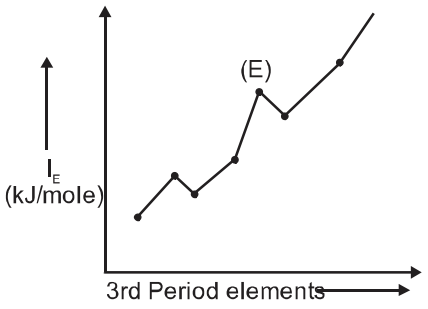
Consider the variation of ionization energy across the $3^{\text {rd }}$ period $L \rightarrow R$. (Left to right) What is the element E?
Image
The potential for the given half cell at $298 \mathrm{~K}$ is $(-)$ $(-) \ldots \ldots \ldots . . \times 10^{-2} \mathrm{~V} .$

$2 \mathrm{H}_{(\mathrm{aq})}^{+}+2 \mathrm{e}^{-} \rightarrow \mathrm{H}_2(\mathrm{~g})$

${\left[\mathrm{H}^{+}\right]=1 \mathrm{M}, \mathrm{P}_{\mathrm{H}_2}=2 \mathrm{~atm}}$

(Given: $2.303 \mathrm{RT} / \mathrm{F}=0.06 \mathrm{~V}, \log 2=0.3$ )

Calculate the $pOH$ of a solution at $25\,^o C$ that contains $1 \times 10^{-10} \, M$ of hydronium ions, i.e. $H_3O^+.$