MCQ
Which of the following statements are true for wave motion:
  • A
    Mechanical transverse waves can propagate through all mediums.
  • B
    Longitudinal waves can propagate through solids only.
  • Mechanical transverse waves can propagate through solids only.
  • D
    Longitudinal waves can propagate through vacuum.

Answer

Correct option: C.
Mechanical transverse waves can propagate through solids only.
In case of mechanical transverse wave propagates through a medium, the medium particles oscillate right angles to the direction of wave motion or energy propagation. It travels in the form of crests and troughs.
When mechanical transverse wave propagates through a medium element of the medium is subjected to shearing stress. Solids and strings have shear modulus, that is why, sustain shearing stress. Fluids have no shape of their own, they yield to shearing stress. Transverse waves can be transmitted through solids, they can be setup on the surface of liquids. But they cannot be transmitted into liquids and gases.
Need a full question paper?

Generate a complete, print-ready paper with questions like this in minutes — across 16+ boards, with answer keys.

Start Generating Free

Similar questions

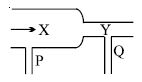
A steady flow of water passes along a horizontal tube from a wide section $X$ to the narrower section $Y$, see figure. Manometers are placed at $P$ and $Q$ at the sections. Which of the statements $A, B, C, D, E$ is most correct?
Which of the following is the most elastic substance?
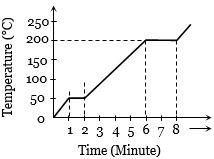
A student takes $50\,gm$ wax $($specific heat $= 0.6\, kcal/kg°C)$ and heats it till it boils. The graph between temperature and time is as follows. Heat supplied to the wax per minute and boiling point are respectively
Match List$-I$ with List$-II.$

List$-I$ List$-II$
$(a)$ Torque $(i)$ ${MLT}^{-1}$
$(b)$ Impulse $(ii)$ ${MT}^{-2}$
$(c)$ Tension $(iii)$ ${ML}^{2} {T}^{-2}$
$(d)$ Surface Tension $(iv)$ ${MI} {T}^{-2}$

Choose the most appropriate answer from the option given below :

Three processes form a thermodynamic cycle as shown on $P-V$ diagram for an ideal gas. Process $1 \rightarrow 2$ takes place at constant temperature $(300K$). Process $2 \rightarrow 3$ takes place at constant volume. During this process $40J$ of heat leaves the system. Process $3 \rightarrow 1$ is adiabatic and temperature $T_3$ is $275K$. Work done by the gas during the process $3 \rightarrow 1$ is ..... $J$
A particle moves towards east with velocity $5\ m/s$ . After $10\ seconds$ its direction changes towards north with same velocity. The average acceleration of the particle is 
A big explosion on the moon cannot be heard on the earth because
The velocity of a body depends on time according to the equation $v=\frac{t^2}{10}+20$. The body is undergoing
A particle $A$ is projected vertically upwards. Another identical particle $B$ is projected at an angle of $45^o $ . Both reach the same height. The ratio of the initial kinetic energy of $A$ to that of $B$ is
Two projectile thrown at $30^{\circ}$ and $45^{\circ}$ with the horizontal respectively, reach the maximum height in same time. The ratio of their initial velocities is