MCQ
Which of the following statements are true?
$a.$ Only type of interactions between particles of noble gases are due to weak dispersion forces.
$b.$ Ionisation enthalpy of molecular oxygen is very close to that of xenon.
$c.$ Hydrolysis of $\ce{XeF_6}$ is a redox reaction.
$d.$ Xenon fluorides are not reactive.
  • $a$ and $b$
  • B
    $a$ and $c$
  • C
    $b$ and $c$
  • D
    $a$ and $d$

Answer

Correct option: A.
$a$ and $b$
Weak dispersion forces are present between particles of noble gases. Ionization enthalpy of molecular oxygen is very close to that of xenon.

Need a full question paper?

Generate a complete, print-ready paper with questions like this in minutes — across 16+ boards, with answer keys.

Start Generating Free

Similar questions

In which of these processes platinum is used as a catalyst
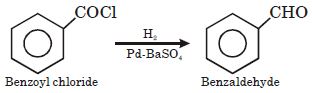
The above reaction is know as :-
The rates of a certain reaction $(dc/dt)$ at different times are as follows

Time                                 Rate (mole $litre^{-1}\,sec^{ -1}$ )

$0$                                        $2.8 \times {10^{ - 2}}$

$10$                                      $2.78 \times {10^{ - 2}}$

$20 $                                     $2.81 \times {10^{ - 2}}$

$30$                                       $2.79 \times {10^{ - 2}}$

The reaction is

For a first order reaction, the rate of reaction is $2.4 \times 10^{-3}\ mol\, l^{-1}\, s^{-1}$ at $27\,^oC$ . The activation energy of reaction is $24.942\ kJ/mol$ . The rate of reaction at $327\,^oC$ is ....... $mol\,\,{l^{ - 1}}\,{s^{ - 1}}$ [Take $e^5 = 150$ , $e^{0.005} = 1$ , $e^4 = 55$ ]
A compound of a metal ion $M^{x+}$ $(Z = 24)$ has a spin only magnetic moment of $\sqrt {15}$ Bohr Magnetons. The number of unpaired electrons in the compound are
Reaction of propanamide with ethanolic sodium hydroxide and bromine will give
The lattice site in a pure crystal cannot be occupied by $.......:$
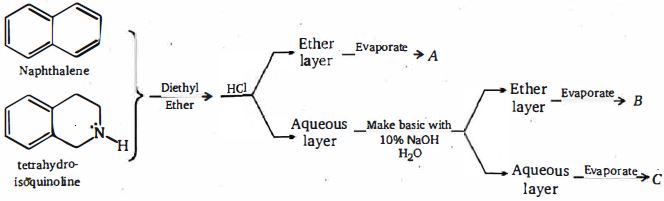
Choose the statement that is true about $A, B$ and $C$ in the following  separation scheme.
What is the activation energy for a reaction if its rate doubles when the temperature is raised from $20\,^oC$ to $35\,^oC$ ........ $kJ \,mol^{-1}$

$(R = 8.314\, J \,mol^{-1}\, K^{-1})$

The concentration of $R$ in the reaction $R \rightarrow P$ was measured as a function of time and the following data is obtained:

$[R]$ (molar) $1.0$ $0.75$ $0.40$ $0.10$
$\mathrm{t}$ (min.) $0.0$ $0.05$ $0.12$ $0.18$

The order of the reaction is