Question
Which of the following statements indicates that light waves are transverse(a) Light waves can travel in vacuum(b) Light waves show interference(c) Light waves can be polarized(d) Light waves can be diffracted


Answer

(c) Light waves can be polarized

Need a full question paper?

Generate a complete, print-ready paper with questions like this in minutes — across 16+ boards, with answer keys.
Start Generating Free

Similar questions

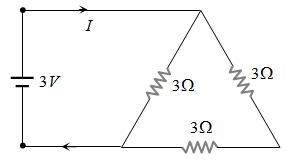
A $3$ volt battery with negligible internal resistance is connected in a circuit as shown in the figure.  The current $I,$ in the circuit will be
Two capacitors connected in parallel having the capacities $C_1$ and $C_2$ are given $'q\ '$ charge, which is distributed among them. The ratio of the charge on $C_1$ and $C_2$ will be
Two samples $A$ and $B$ are initially kept in the same state. Sample $A$ is expanded through an adiabatic process and the sample $B$ through an isothermal process. The final volumes of the samples are the same. The final pressures in $A$ and $B$ are $p_A$ and $p_{B }$ respectively.
A resistor of resistance R is connected to an ideal battery. If the value of R is decreased, the power dissipated in the resistor will:
Which of the following electromagnetic waves is used in medicine to destroy cancer cells?
A 220 volt, 1000 W bulb is connected across a 110 volt mains supply. The power consumed will be(a) 1000 W(b) 750 W(c) 500 W(d) 250 W
       
Two non ideal batteries are connected in series. Consider the following statements
(A) The equivalent emf is larger than either of the two emfs.
(B) The equivalent internal resistance is smaller than either of the two internal resistances.
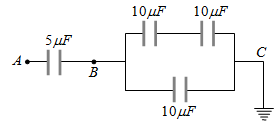
In the given circuit if point $C$ is connected to the earth and a potential of $+2000 V$  is given to the point $A,$ the potential at $B$ is
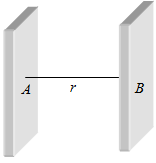
There are two equipotential surface as shown in figure. The distance between them is $r.$ The charge of $–q$ coulomb is taken from the surface $A$ to $B,$ the resultant work done will be
Consider the motion of the tip of the minute hand of a clock. In one hour:
  1. The displacement is zero.
  2. The distance covered is zero.
  3. The average speed is zero.
  4. The average velocity is zero.