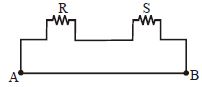
Which of the following statements is false?
JEE MAIN 2017, Easy


Download our appand get started for free
Experience the future of education. Simply download our apps or reach out to us for more information. Let's shape the future of learning together!No signup needed.*
Similar Questions
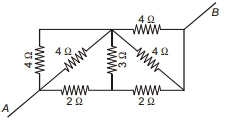
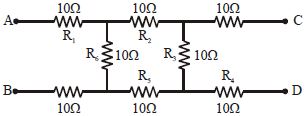
- 1Resistance across $A B$ as shown in figure is ............. $\Omega$View Solution
- 2Two resistances of $400$ $\Omega$ and $800$ $\Omega$ are connected in series with $6\, volt$ battery of negligible internal resistance. A voltmeter of resistance $10,000$ $\Omega$ is used to measure the potential difference across $400$ $\Omega$. The error in the measurement of potential difference in volts approximately isView Solution
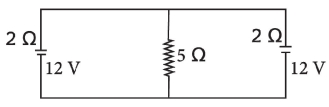
- 3In the arrangement shown in figure, the current through $5\,\Omega$ resistor is ............. $A$View Solution
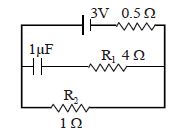
- 4A $1\,\mu F$ capacitor is connected in the circuit shown below. The emf of the cell is $3\ volts$ and internal resistance is $0.5\ ohms$ . The resistors $R_1$ and $R_2$ have values $4\ ohms$ and $1\ ohm$ respectively. The charge on the capacitor in steady state must be.......$\mu C$View Solution
- 5In Wheatstone's bridge $P = 9\, ohm$, $Q = 11\, ohm$, $R = 4\,ohm$ and $S = 6\,ohm$. How much resistance must be put in parallel to the resistance $S$ to balance the bridge ............... $ohm$View Solution
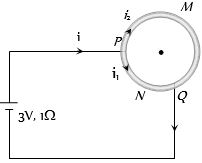
- 6A wire of resistance $10$ $\Omega$ is bent to form a circle. $P$ and $Q$ are points on the circumference of the circle dividing it into a quadrant and are connected to a Battery of $3\, V$ and internal resistance $1$ $\Omega$ as shown in the figure. The currents in the two parts of the circle areView Solution
- 7The equivalent resistance between the points $A$ and $D$ ................ $\Omega$View Solution
- 8Two electric bulbs marked $40\,W,$ $220\,V$ and $60\,W,\,\,220\,V$ when connected in series across same voltage supply of $220\,V,$ the effective power is $P_1$ and when connected in parallel, the effective power is $P_2.$ Then $\frac {P_1}{P_2}$ isView Solution
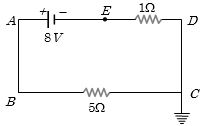
- 9In the given circuit, the potential of the point $E$ isView Solution
- 10In a meter bridge, the null point is found at a distance of $25\, cm$ from $A$ . If now a resistance of $10\,\Omega $ is connected in parallel with $S$, the null point occurs at mid point of $AB$. The value of $R$ is .............. $\Omega$View Solution