MCQ
Which of the following statements is false?
  • A
    Tea can be separated from the leaves by filtration.
  • A mixture of salt and sand can be separated by distillation.
  • C
    Winnowing will separate wheat grains from husk and dust.
  • D
    A mixture of sand and salt is partially soluble in water.
Answer

Correct option: B.
A mixture of salt and sand can be separated by distillation.
A mixture of salt and sand can be separated by filtration not by distillation.

Need a full question paper?

Generate a complete, print-ready paper with questions like this in minutes — across 16+ boards, with answer keys.

Start Generating Free

Similar questions

Swati classified a few changes occurring around us as shown in the table.
S.No.
Changes
Type
$1.$
Sharpening of pencil.
Physical, reversible.
$2.$
Evaporation of water.
Physical, irreversible.
$3.$
Opening of a bud.
Chemical irreversible.
$4.$
Rusting of iron.
Chemical reversible.
Which of the changes is/ are classified correctly$?$
Parts of plants which are eatable are known as:
The fat soluble vitamins are:
Which of the following symptoms is shown by a person whose diet is deficient in proteins?
One centimeter on a scale is divided into $20$ equal divisions. The least count (minimum value) of this scale is
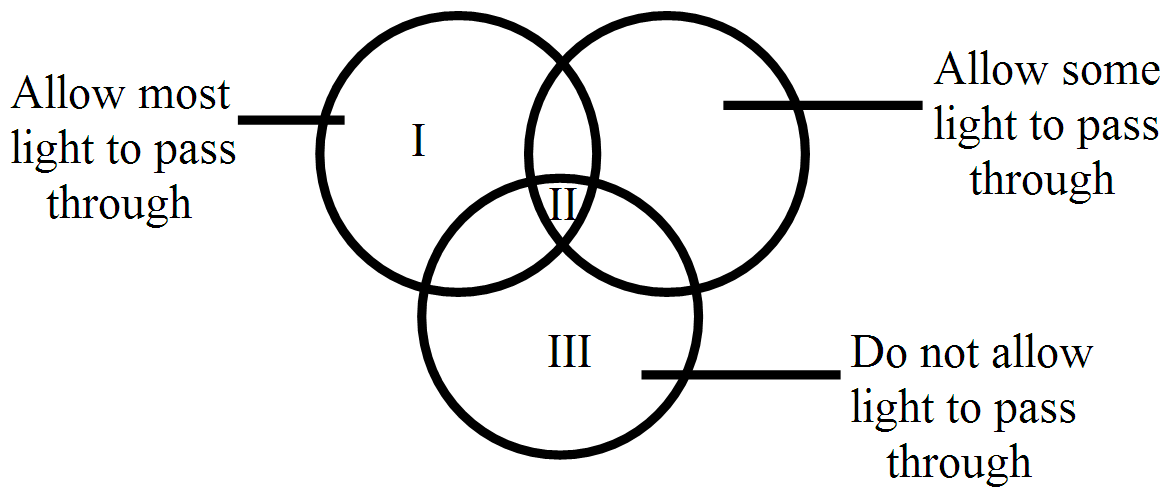
DIRECTIONS: Read the passage(s) given below and answer the questions that follow. Passage - Study the Venn diagram given below that represents the characteristics that materials may have. On the basis of the diagram answer the following questions.

Which of the following substance represent $(I)?$
To fix up the fractured bone a paste made of plaster of parts $(POP)$ is used as a coating over the bandage on the fractured bone. After some time the plaster becomes hard and dry. This change in $POP$ can be classified:
How many grams of copper sulphate be dissolved in $100\ ml$ of water to prepare copper sulphate solution for testing the presence of proteins in a food item?
Match the entries in Column$-I$ with those in Column$-II.$
S.No.
Column - $I$
S.No.
Column - $II$
$a.$
A chalk water mixture
$1.$
A gaseous mixture
$b.$
 
A glucose solution
$2.$
A heterogeneous solid-liquid mixture
$c.$
Carbonated water
$3.$
A homogeneous solid-liquid mixture
$d.$
Air
$4.$
A gas - liquid mixture
The thick view in the middle of the leaf is: