MCQ
Which of the following statements is not correct
  • A
    During pure rolling, the instantaneous speed of the point of contact is zero.
  • During pure rolling, the instantaneous acceleration of the point of contact is zero.
  • C
    For perfect rolling motion, work done against friction is zero.
  • D
    A wheel moving down a perfectly frictionless inclined plane will slip but not roll on the plane.

Answer

Correct option: B.
During pure rolling, the instantaneous acceleration of the point of contact is zero.
b
A rolling body can be imagined to be rotating about an axis passing through the point  of contact of the body with the ground. Hence, the instantaneous speed of the point  of contact is zero. 

Thus, statement $(a)$ is correct. 

As the body is rotating, its  instantaneous acceleration is not zero. 

Hence, statement $(b)$ is incorrect. 

Once  perfect the rolling begins, force of friction becomes zero. Hence, work done against  friction is zero. 

Thus, statement $(c)$ is correct. 

Rolling cannot take place in the  absence of friction because it is the frictional force that provides the necessary torque  which makes the body roll on a surface. When the inclined plane is perfectly  smooth, the wheel will simply slip under the effect of its weight. 

Hence, statement $(d)$  is correct. 
Need a full question paper?

Generate a complete, print-ready paper with questions like this in minutes — across 16+ boards, with answer keys.

Start Generating Free

Similar questions

The current of $5 \mathrm{~A}$ flows in a square loop of sides $1$ $\mathrm{m}$ is placed in air. The magnetic field at the centre of the loop is $\mathrm{X} \sqrt{2} \times 10^{-7} \mathrm{~T}$. The value of $\mathrm{X}$ is____.
What could be a correct expression for the speed of ocean waves in terms of its wavelength $\lambda $ , the depth $h$ of the ocean, the density $\rho $ of sea water, and the acceleration of free fall $g$ ?
Which of the following is not true for this progressive wave $y = 4\sin 2\pi \left( {\frac{t}{{0.02}} - \frac{x}{{100}}} \right)$ where $y$ and $x$ are in $cm$ & $t$ in $sec$
The acceleration of a moving body can be found from
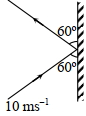
A body of mass $3 \ kg$ hits a wall at an angle of $60^\circ$ and returns at the same angle. The impact time was $0.2s$ Calculate the force exerted on the wall
A charge $( - q)$ and another charge $( + Q)$ are kept at two points $A$ and $B$ respectively. Keeping the charge $( + Q)$ fixed at $B$, the charge $( - q)$ at $A$ is moved to another point $C$ such that $ABC$ forms an equilateral triangle of side $l$. The net work done in moving the charge $( - q)$ is
A particle of mass $m$ moves in circular orbits with potential energy $V ( r )=F r$, where $F$ is a positive constant and $r$ is its distance from the origin. Its energies are calculated using the Bohr model. If the radius of the particle's orbit is denoted by $R$ and its speed and energy are denoted by $v$ and $E$, respectively, then for the $n ^{\text {th }}$ orbit (here $h$ is the Planck's constant)-

$(A)$ $R \propto n ^{1 / 3}$ and $v \propto n ^{2 / 3}$

$(B)$ $R \propto n ^{2 / 3}$ and $v \propto n ^{1 / 3}$

$(C)$ $E=\frac{3}{2}\left(\frac{n^2 h^2 F^2}{4 \pi^2 m}\right)^{1 / 3}$

$(D)$ $E=2\left(\frac{n^2 h^2 F^2}{4 \pi^2 m}\right)^{1 / 3}$

A particle moves along a straight line $OX$ . At a time $t$ (in seconds) the distance $x$ (in metres ) of the particle from $O$ is given by $x = 40 + 12t - {t^3}$.How long would the particle travel before coming to rest ?..........$m$
An infinite number of charges each numerically equal to q and of the same sign are placed along the $x-$ axis at $x = 1,2,4,8.... \,metres$. Then the electric potential at $x = 0$ due to this set of charges is
By opening the door of a refrigerator placed inside a room you