MCQ
Which of the following statements is not correct?
  • A
    Copper liberates hydrogen from acids.
  • B
    In its higher oxidation states, manganese forms stable compounds with oxygen and fluorine.
  • C
    Mn3+ and Co3+ are oxidising agents in aqueous solution.
  • D
    Ti2+ and Cr2+ are reducing agents in aqueous solution.

Answer

  1. Copper does not liberates hydrogen from acids.

Explanation:

$\text{Cu}+2\text{H}_2\text{SO}_4\rightarrow\text{CuSO}_4+\text{SO}_2+2\text{H}_2\text{O}$

$3\text{Cu}+8\text{H}\text{NO}_3\rightarrow3\text{Cu(NO}_3)_2+2\text{NO}+4\text{H}_2\text{O}$

Need a full question paper?

Generate a complete, print-ready paper with questions like this in minutes — across 16+ boards, with answer keys.

Start Generating Free

Similar questions

The half life period of a first order reaction
Van't Hoff factor $i$
Among the following substances the lowest vapour pressure is exerted by:
Water soluble vitamine is
.
Which of the following is correct order of ligand field strength?
Consider the reaction

$(i)\,\,(CH_3)_2CH-CH_2Br \xrightarrow{{{C_2}{H_5}OH}} (CH_3)_2CH-CH_2OC_2H_5 + HBr$

$(ii)\,\,(CH_3)_2CH-CH_2-Br \xrightarrow{{{C_2}{H_5}{O^- }}} (CH_3)_2CH-CH_2OC_2H_5 + Br^-$

The mechanisms of reaction $(i)$ and $(ii)$ are respectively

The concentration of potassium ions inside a biological cell is at least twenty times higher than the outside. The resulting potential difference across the cell is important in several processes such as transmission of nerve impulses and maintaining the ion balance. A simple model for such a concentration cell involving a metal $\mathrm{M}$ is:

$\mathrm{M}(\mathrm{s}) \mid \mathrm{M}^{+}$(aq; $0.05$ molar) || $\mathrm{M}^{+}(\mathrm{aq}), 1$ molar) $\mid \mathrm{M}(\mathrm{s})$

For the above electrolytic cell the magnitude of the cell potential $\left|E_{\text {cell }}\right|=70 \mathrm{mV}$.

$1.$ For the above cell

$(A)$ $\mathrm{E}_{\text {cell }}<0 ; \Delta \mathrm{G}>0$ $(B)$ $\mathrm{E}_{\text {cell }}>0 ; \Delta \mathrm{G}<0$

$(C)$ $\mathrm{E}_{\text {cell }}<0 ; \Delta \mathrm{G}^{\circ}>0$ $(D)$ $\mathrm{E}_{\text {cell }}>0 ; \Delta \mathrm{G}^{\circ}>0$

$2.$ If the $0.05$ molar solution of $\mathrm{M}^{+}$is replaced by $0.0025$ molar $\mathrm{M}^{+}$solution, then the magnitude of the cell potential would be

$(A)$ $35 \mathrm{mV}$ $(B)$ $70 \mathrm{mV}$ $(C)$ $140 \mathrm{mV}$ $(D)$ $700 \mathrm{mV}$

Give the answer question $1,2.$ 
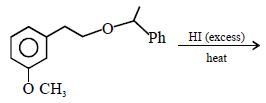
A mixture of benzaldehyde and formaldehyde on heating with concen. and hot NaOH gives :
Major product ' $P$ ' formed in the following reaction is:-
