MCQ
Which of the following statements is not correct?
  • A
    Proteins are poly amides formed from aminoacids.
  • B
    Except glycine, all other amino acids show optical activity.
  • C
    Natural proteins are made up of L isomers of amino acids.
  • D
    In amino acids NH2​ and COOH groups are attached to different carbon atoms.
Answer

  1. In amino acids NH2 ​and COOH groups are attached to different carbon atoms.

Explanation:

  1. Proteins are poly amides formed from alpha amino acids. Thus, the option A is correct.
  2. Except glycine, all other amino acids show optical activity as they contain chiral carbon atom. Glycine is achiral. Thus, option B is correct.
  3. Natural proteins are made up of L isomers of amino acids. Thus, statement C is correct.
  4. In amino acids NH2​ and COOH groups are attached to same carbon atom.

Need a full question paper?

Generate a complete, print-ready paper with questions like this in minutes — across 16+ boards, with answer keys.

Start Generating Free

Similar questions

Which of the following is not a consequence of the Lanthanoid contraction?
The rate constant of a reaction increases by five times on increase in temperature from $27^{\circ} C$ to $52^{\circ} C$. The value of activation energy in $kJ mol ^{-1}$ is $.... .$ (Rounded-off to the nearest integer) $\left[ R =8.314\, J \,K ^{-1} \,mol ^{-1}\right]$
Which one of the following will produce a primary alcohol by reacting with $C{H_3}MgI$
Which among the following reaction will take place spontaneously
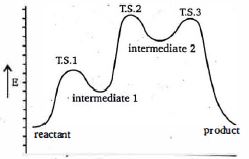
Transition state $2$ is structurally most likely as
The pressure that a single component in a gaseous mixture would exert if it existed alone in the same volume as the mixture and at the same temperature as the mixture is referred to as.
For the given cell ; $Cu ( s )\left| Cu ^{2+}\left( C _{1} M \right) \| Cu ^{2+}\left( C _{2} M \right)\right| Cu ( s )$ change in Gibbs energy $(\Delta G )$ is negative, if :
Conversion of benzene diazonium chloride to chlorobenzene is an example of which of the following reactions?
Liquids $A$ and $B$ form ideal solution over the entire range of composition. At temperature T, equimolar binary solution of liquids $A$ and $B$ has vapour pressure $45$ Torr. At the same temperature, a new solution of $A$ and $B$ having mole fractions $x _{ A }$ and $x _{ B }$, respectively, has vapour pressure of $22.5$ Torr. The value of $x_A / x_B$ in the new solution is . . . . . that the vapour pressure of pure liquid $A$ is $20$ Torr at temperature $T$ )
Match List $I$ with List $II$

LIST $-I$

(Cell)

LIST $-II$

(Use/Property/Reaction)

$A$ Leclanche

cell

$I$ Converts energy of combustion into electrical energy
$B$ Ni-Cd cell $II$ Does not involve any ion in solution and is used in hearing aids
$C$ Fuel cell $III$ Rechargeable

$D$ Mercury cell

$IV$ Reaction at anode

$\mathrm{Zn} \rightarrow \mathrm{Zn}^{2+}+2 \mathrm{e}^{-}$

Choose the correct answer from the options given below: